
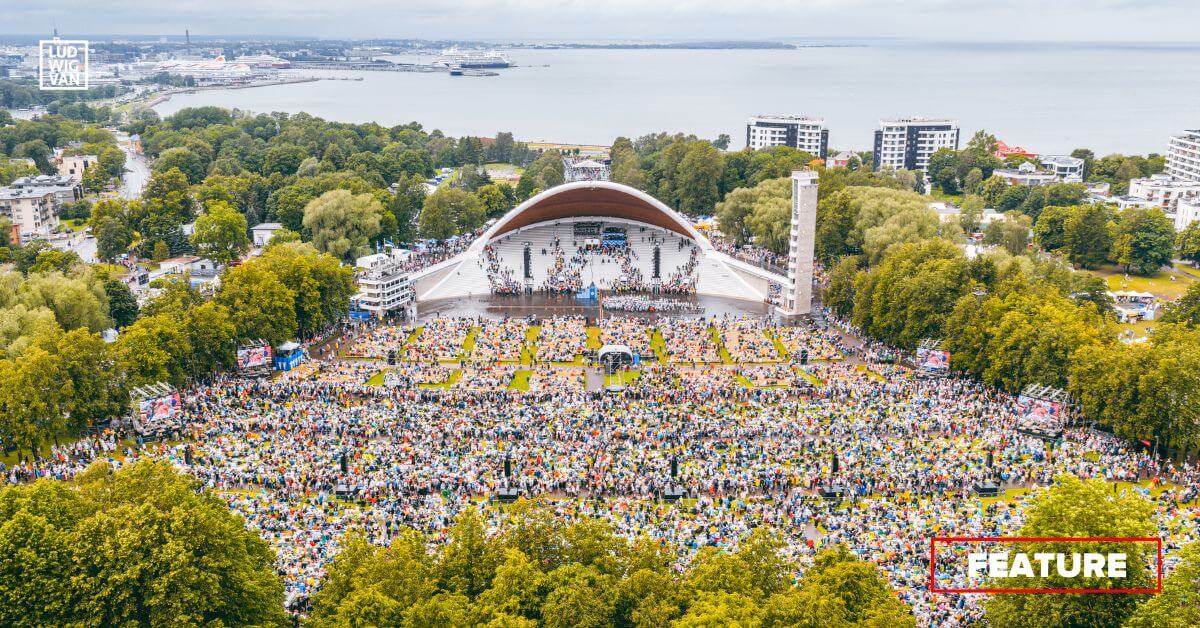
For Estonia, a small country in the Baltic with a population of 1.3 million, singing together is not only a tradition but a powerful, active national identity. Their song festival, Eesti Üldlaulupidu, commonly called Laulupidu, first held in 1869 in Tartu, led Estonians through difficult times, including Nazi and Soviet occupations.
Since that first festival, Laulupidu has gone through a bit of change over the last 150+ years, including a change of venue from Tartu to Tallinn’s Song Festival Ground, the addition of the festival flame that travels through all 15 Estonian counties, and amalgamation with the national dance festival.
This tradition (“Baltic song and dance celebrations”), which includes three countries: Estonia, Latvia, and Lithuania, was recognized by UNESCO’s Representative List of the Intangible Cultural Heritage of Humanity in 2003.
Laulupidu 2025
For the 2025 edition, with the theme “Iseoma” (Kinship), 40,000 musicians and dancers, including Estonian diaspora from overseas — such as Toronto Eesti Meeskoor (Toronto Estonian Male Voice Choir, founded in 1950), the Kungla Folkdance Group, and others — joined the crowd of 100,000, making it the largest Laulupidu ever held.
For Torontonians, the best way to travel to Tallinn is to transit through Warsaw with LOT Polish airline, KLM via Amsterdam, or Air Canada/Lufthansa via Frankfurt; however, travelling to Helsinki or Stockholm, then taking the ferry to Tallinn is also a great option. English is widely spoken, and public transit is very well organized.
During the song festival, local transit is free for the public, and the ride-share program Bolt, an Estonian company established in 2014, fills in any gaps in the transit nicely, as it includes options for e-scooters, rental cars, and ride services.
The 4 show tickets for 2025 — two for dance, and two for song (with the exception of the folk music performance on the Friday afternoon held in Vabaduse väljak, Freedom Square, which was free to the public), went up for sale in January 2025. The dance tickets were quickly sold out by mid-March, and the final concert — easily lasting over 7 hours — sold out with weeks to go, which was surprising even for the locals. With Estonia becoming more familiar to the international crowd, as it’s been at the forefront of eCommerce and Digital Nomad Visa programs; for those who want to attend the next Laulupidu, early ticket purchase would be highly recommended.
The selection for the choirs starts 1.5-2 years before every festival, and the festival committee tries their very best to be inclusive, selecting groups from beginners and children’s groups, right up to professional choirs and singers. For the 2025 festival, the committee had to make many hard decisions, as the sheer amount of initial applications — especially as this was the first full-scale festival post-COVID — could not be accommodated safely, even in the vast space of the Song Festival Ground, with its maximum capacity of 15,000 performers and 100,000 audience members. To sing at Laulupidu, every choir must pass two rounds of auditions at the regional level.
The Estonian Diaspora
As the festival includes all ages, it is common to see generations of families participating, both as singers and audience members; groups of friends often sing together from kindergarten to old age. Kristina Maria Agur, Toronto-born Canadian-Estonian who is currently working in Vienna as an opera singer, has been singing in Laulupidu, through her father, Enno Agur’s connection; Enno, who sings with the Estonia Koor Toronto choir, has travelled to Estonia for every Laulupidu since 1999.
The Estonian diaspora, from the long dark days of German and Soviet occupations, has travelled far and wide in this world; many who have been exiled were never allowed to return to their homes.
Through singing — both at home and abroad — many Estonians have kept their heritage alive through the generations; an exceptional achievement.
The Festival
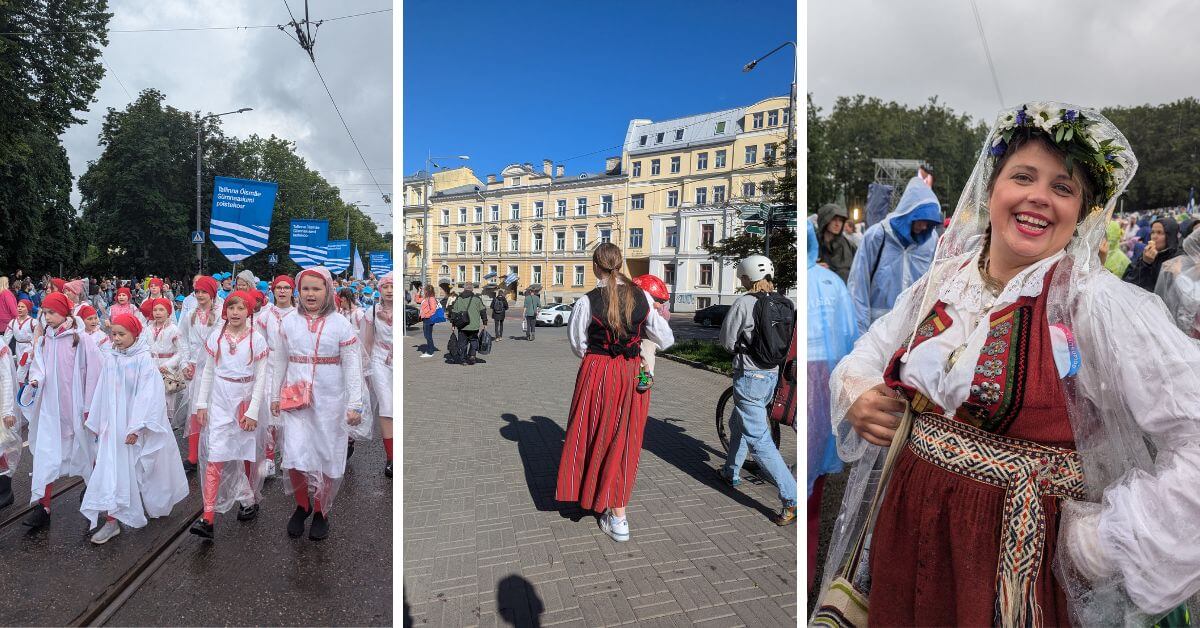
On the afternoon of Saturday July 5, everyone gathered around Freedom Square to start the grand procession to the Tallinn Singing Festival Ground — a 5 km march. This year, it rained heavily; 38mm of rain was reported for the weekend from Saturday 9 a.m. till Sunday 9 p.m., but it couldn’t stop the musicians, dancers, and the accompanying audience from walking through wind and pouring rain.
Everyone got on with it stoically, protecting their lovely costumes under clear rain gear. This year, the parade started around 1 p.m., to get everyone ready backstage for 7 p.m. for the 7:30 p.m. opening. The road was packed with cheers and singing — it was quite a sight to behold.
The first of the two singing festival days starts with everyone assembled on the stage, as the festival flame, lit in Tartu on June 15th and having passed through all 15 counties, arrives at the Song Ground. The festival started with the traditional opener, “Koit (Dawn),” Music by Mihkel Lüdig (1880–1958), and text by Friedrich Kuhlbars (1841–1924).
Once the flame was lit on the tower, the mass choir in various formats sang over the two days; once a group is assembled on the stage, their song title, composer, and conductor’s name are announced, followed by rapturous applause for the crowd favourites — before and after singing.
This amazing cheering of musicians and songs rivals major international sports events’ energy, and it’s very touching to see all performers wholeheartedly express their love for singing.
Imagine being an Estonian, and having a favourite composer, and/or conductor throughout your life, from childhood to your last days — some patriotic and some familiar numbers had the crowd proudly singing along, making the sky resonate.
Once a song finished, the congratulations and flower presentations took over, and often, the group burst into a spontaneous encore, everyone patiently waiting till the next in order.
The repertoire includes old favourites and new commissions. The impact of this constant commissioning and new music performance in both musical and non-musical senses is perhaps immeasurable, yet very real — as each song has the potential to become a lifelong favourite.
Events
Here’s the order of events for Sunday’s closing concert:
- 13:20 Brass Band
- 14:25 Boys and Male Choir
- 15:10 Toddlers Choir
- 15:55 Female Choir
- 16:20 Symphony Orchestra
- 17:25 Childrens Choir
- 18:15 Male Choir
- 19:45 Final Choir: Male and Female
- 20:10 Graduation Choir, Children’s Choir, Boys Choir, Group Instructors
Despite the official timetable, with enthusiastic encores and cheers, the events ran well over the proposed 7 hours. The traditional last song “Mu isamaa on minu arm (My Father land is My Love),” text by Lydia Koidula and music by Aleksander Kunileid, was followed by Neeme Järvi conducting the ending encore, “Kodumaa”.
Yes, the famous Järvi family is Estonian. Pärnu Music Festival is run by all three Järvis; Paavo, Neeme and Kristjian, together with Leonid Grin, as a conducting and instrumental academy, another intense international summer classical music event held in Estonia.
Experience Estonian Song
With everyone focused on the festival through actively singing and dancing from childhood to old age, along with consistent national television coverage, the Laulupidu is an amazing way to build a positive national identity. The fact that a nation can gather together geographically every five years is a striking advantage; it would be so much more difficult logistically and financially for Canada, for example.
Against all odds, Estonians have faced constant national threats by being together, and their continued singing and dancing carries values far beyond a single generation. Between the five-year gap, there’s also the Youth Song and Dance Celebration, further enriching the Estonian experience. Here’s the current schedule, including this year’s festival:
- July 3-6, 2025: XXVIII Song Celebration and XXI Dance Celebration
- July 1-2, 2028: XXII General Dance Festival and XIV Youth Dance Festival will take place at Kalev Stadium
- July 8-9, 2028: XXIX General Song Festival and XIV Youth Song Festival will take place at Tallinn Song Festival Grounds
Interested parties could also check out the Lithuanian song and dance festival (held every four years, last one was in 2024), and the Latvian festival (next one is in 2028).
So mark your calendar for 2030, and see where life takes you. There is something special about such a gathering where 40,000 voices come together to simply be together, and celebrate their national identity with flair and true brotherhood. Perhaps, amid nationalism fever, rather than blindly waving flags, we should be reminded of the simple power of being together, and singing together.
Are you looking to promote an event? Have a news tip? Need to know the best events happening this weekend? Send us a note.
#LUDWIGVAN
Get the daily arts news straight to your inbox.