
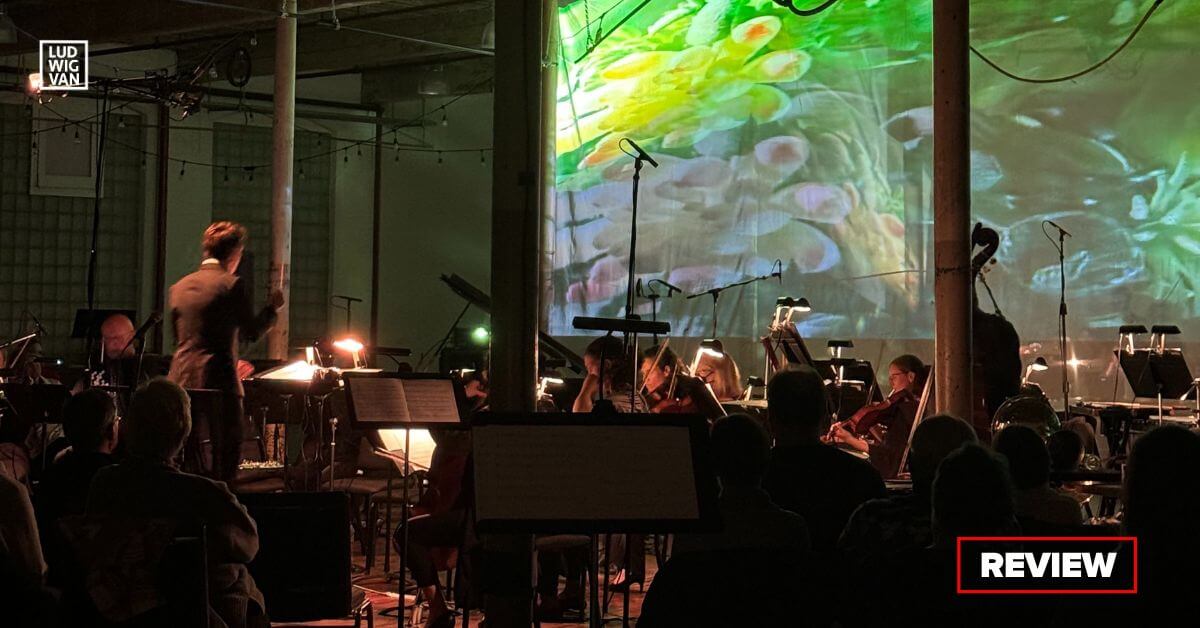
Intimate & Immersive: the Five Senses. Abigail Richardson-Schulte, Bloom; *Tsz Long (Fish) Yu, The Breath of Spring (world premiere); Linda Catlin Smith, Gold Leaf; Violeta Cruz, Vire Vole (*HPO Composer Fellow 2024-2025). Hamilton Philharmonic Orchestra, James S. Kahane, conductor; Josef Petric, accordion; projections by OPTIKS. February 27, 2025 at The Cotton Factory, Hamilton, ON.
New music of any kind needs an introduction, and the right setting. That’s what the Hamilton Philharmonic and Music Director James S. Kahane demonstrated with the program The Five Senses.
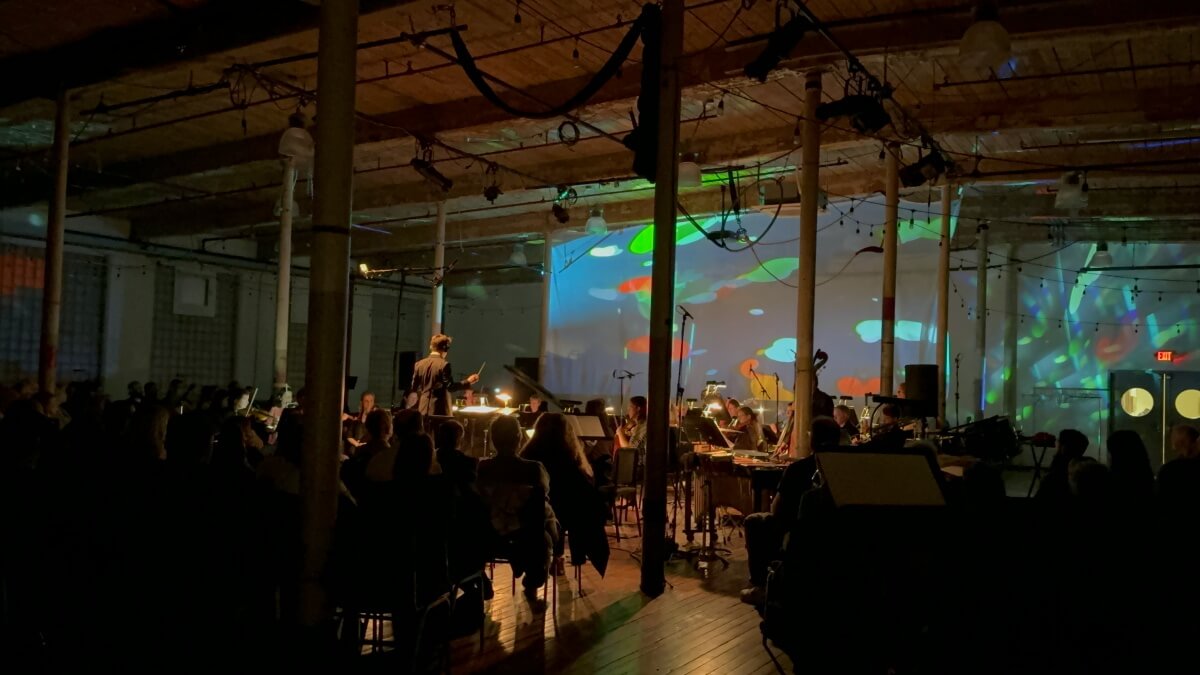
The Hamilton Philharmonic’s Intimate & Immersive concert series showcases contemporary classical music in an atmospheric renovated Victorian industrial warehouse loft. With seating in three to five rows of chairs surrounding the orchestra on three sides, projections on a large screen behind the musicians, and a bar in the corner, the concert, and program, were designed to offer an experience beyond the music.
Judging from the large and appreciative crowd on Thursday evening, it’s a combination that’s working well.
First Half
HPO Composer-in-residence Abigail Richardson-Schulte acted as emcee for the evening, alongside Music Director James S. Kahane. Richardson-Schulte’s own work Bloom opened the program, and she related the incredible story behind its inspiration. Abigail was born in the UK, and after a series of ear infections, became deaf as a young child. However, she was so adept at lip reading, and essentially faking it, that no one was aware until her family applied to immigrate to Canada. The medical exam resulted in their application being initially denied.
It sparked a fight to battle the decision, but also a revolution for Richardson-Schulte’s life. After consultations with multiple specialists, one finally suggested that the dry air of Calgary, Alberta, where her dad had a job offer, might be good for her. As it happened, he was right. Not long after moving there, her hearing began to restore itself.
The composition, a concerto featuring soloist Josef Petric on the accordion, is a kind of retelling of that story in music, from the first movement, where the sounds are disjointed in what she calls an “uncomfortable fit”, with keening strings that expressed her anxieties, through an emotional journey to where she is today. The third movement was particularly affecting in its portrayal of a world opening up.
Richardson-Schulte’s music is melodic, and quite effective in conveying the emotional story. The combination of accordion and a largely string ensemble produced some interesting sounds. At times, the instrument has a pipe organ-like quality.
The audience was seated close enough to hear the movement of Petric’s keys, adding to the effect.
The composer for the second piece, The Breath of Spring by HPO Composer Fellow for 2024-2025 Tsz Long (Fish) Yu, was also on hand to talk about his work. Fish is an audio engineer as well as a composer, and he adds electronics and synthesizer to the orchestral colours and textures.
Abigail mentioned evaluating the composition with the HPO. “We said yes, if you handle the elecronics.”
His goal in the piece is to offer a soundscape of the transition from winter to spring, incorporating Toronto street sounds and other recordings that he mixes with the orchestra.
Kahane wore headphones for the piece, which, as he explained later, sounded out a click track that enabled him to conduct both the orchestra in front of him and Fish, behind him.
The piece is rhythmic and textural, and essentially melodic. The electronics added an interesting sheen to the orchestral sounds without taking away from either. It enhanced both the mood and the drama of the work. Yu’s piece has a cinematic kind of sensibility, and the street noises underneath often act as a form of narrative alongside the music.
With its energy and dramatic flair, it was an audience favourite and highlight of the evening.

Second Half
As Kahane explained during his introductory talk, the composers and works of the first half used familiar sounds and idioms in structures that may be innovative, but still harken back to their origins. They sound like pieces with movements that have a kind of trajectory from beginning to end. “It’s music that can be easily understandable,” he told the audience.
The second half, however, offered something different. “I’d say the second half is much more untouchable,” Kahane offered with a smile. He also pointed out that, while the program was initially designed around the idea of touching on the five senses in various ways, themes of loss and rebirth also emerged in all four of the pieces.
“I would like to offer you a slightly different experience.”
The orchestra was enlarged with a piano and enhanced percussion for Linda Catlin Smith’s piece Gold Leaf. It’s a work he likened to a kind of painting using music, where some parts were thickly applied, while others were sparse. Smith’s piece is a sound painting of the leaves turning golden and orange and falling in the autumn.
It’s a composition that works with textures, tones, and colours rather than melody. Percussive piano and other percussion instruments added a shimmering effect over the orchestra. Kahane advised the audience to close their eyes and simply let the sound wash over them, and that’s an appropriate way to experience its gradual shifts in mood.
Colombian composer Violeta Cruz’s piece Vire Vole takes the wind as its inspiration — not only as a force of nature, but as a concept, something that surrounds us, but which we don’t see.
Not surprisingly, woodwinds figure prominently in the piece, which also uses non-traditional methods of sound making like tapping on the accordion, slapping knees, or simply blowing through an instrument. The piece ebbs and flows in energy in repeated patterns and long held notes, emulating the gusts of wind.
Vire Vole captures the mercurial nature of the wind. Towards the end, several musicians moved out of the centre of the area to music stands that had been set up essentially in the audience area. They played bells and other percussion instruments along with their usual violins and saxophones.
Over the course of the piece, the sounds evolved, changed, and moved around. While not emotional in a romantic sense, it was certainly moody and atmospheric. It was a complex work, but it held together through the conviction of the musicians and Kahane’s direction.
Final Thoughts
Overall, Kahane and the HPO handled the many changes of colour and mood over the program deftly. As a conductor, Kahane strikes a good mix of expressive leadership and strict tempo as the often difficult scores require it.
The friendly and intimate atmosphere worked well in the large warehouse loft space, and acoustics were clear (with a tendency towards the loud, especially and understandably so if you were seated close).
The projected images by OPTIKS were, as the collective explained during intermission, created for the event, and were being mixed live with the audio. The flow of images was interesting and expressive, and added to the emotions of the music as it was played.
Music Director Kahane was an affable host, a nice mix of personable and knowledgeable. He was available to chat with audience members during breaks, as were Abigail Richardson-Schulte, Bloom, Tsz Long (Fish) Yu, and some of the musicians.
Even the more esoteric music of the second half was well received by the mixed audience of young and older, and the musicians received a well deserved ovation.
It’s a model for showcasing new music that works.
Are you looking to promote an event? Have a news tip? Need to know the best events happening this weekend? Send us a note.
#LUDWIGVAN
Get the daily arts news straight to your inbox.