

Orchestral music beyond the usual concert hall experience. That’s the focus of a new ensemble, the New Toronto Symphony Orchestra.
In their first concert listing for a performance that took place February 8, NTSO was careful to note, “The New Toronto Symphony Orchestra is not affiliated with or endorsed by the Toronto Symphony Orchestra. We are an independent organization.”
Their aim is not to compete with the city’s venerable orchestra, but to offer a completely different experience of orchestral music. The ensemble is made up of young musicians with classical training who bring a new perspective to the centuries-old genre, focusing on improvisation and multidisciplinary collaborations.
We spoke to the organization’s founder, Zack Goldstein, about the ensemble and its goals.
Zack Goldstein & NTSO
Zack holds an undergraduate degree from the University of Toronto, and a Master of Music from Eastman School of Music. He went on to become an instructor in clarinet at the Eastman Community Music School.
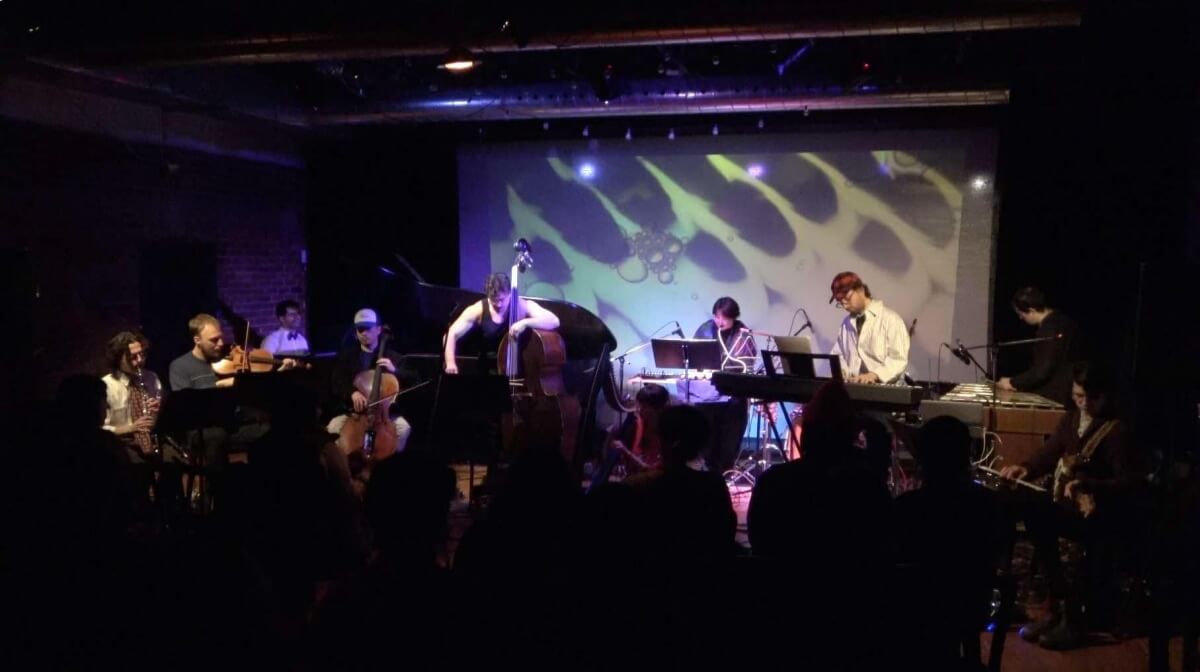
NTSO’s inaugural performance was titled Reduce / Reuse / Recycle, and consisted of free improvisation accompanied by projections by visual artist Adam Kaleta. While the NTSO is a recent phenomenon, it’s been in the works for some time. “I’ve been working on this for a while,” Zack says.
While its composition will be fluid, a list of the members who performed for the first concert reveals a few interesting additions to the usual instrumentation:
- Zack Goldstein, clarinet
- Arie Verheul Van de Ven, viola
- Andrew Park, cello
- Connor Crone, double bass
- Grace Scheele, harp
- Samuel Laramee, guitar and synthesizers
- Ben Mike, alternate tuned piano
- Crescenzo DiCecco, piano
- Jaz Tsui and Louis Pino, percussion
He reports that their inaugural concert was a success. “It was fantastic. I honestly could not have imagined a more perfect realization of this concept,” he says.
Artist Adam Kaleta worked with a sampling board that had been loaded with set pieces he’d created, but the order and how they were projected was improvised live along with the music.
The 10 person ensemble had never performed together before that night.
“I met with everybody one-on-one or one-on-two, but we’d never met together before that night.”
The event, held at ArraySpace, sold out.
“Basically we, the music aspect of it, we used orchestral audition excerpts as the inspiration for improvisation,” he explains.
For example, the group used pieces like the English horn solo from Dvořák 9th Symphony, or the bassoon solo from Paul Dukas’ The Sorcerer’s Apprentice — iconic pieces used by instrumentalists in auditions as fuel for free improvisation.
“For the first half, I curated six ensembles,” he says. They ranged from the full ensemble to chamber groups within it.
For the second half of the concert, the audience curated the concert. Before the event, raffle tickets were available at the front of the house. Anyone who wanted to participate could enter. When their number was picked, the winner got to choose the ensemble for the next round of improvisation.
It blurred the line between orchestra/presenters and audience.
“Everybody was in on it. There was no separation.”

It also tends to blur the lines between contemporary classical music and contemporary jazz. Some of the musicians involved have a jazz oriented background and experience. After a stellar solo, the audience claps in a typical jazz performance. That’s the kind of ambience he’d like to cultivate.
“You can express your feelings, with out being judged.”
The concert’s popularity comes as something of surprise to Zack himself, who says his only real promo was an Instagram post about three weeks before the date, with a few other posts leading up to it.
“The response was really shocking.”
NTSO grew out of smaller shows he’s put on at clubs like Tranzac, where he says he also had an overwhelmingly positive response. “Every place I’d go, I had people coming up to me and saying they resonated with it.”
As he points out, many people quit their music practice after school ends because of economic realities and working in other fields. They lose touch with the music industry and classical music scene in particular, and outside that flow, it’s even harder to get re-established. That’s something Zack would also like to change.
“It’s very clear to me that there’s a space for these musicians who have been forgotten,” he says. Institutions tend to see the potential only in the most exceptional students, and many fall by the wayside in the process. “They were sold an idea, but ended up excluded.” As he notes, there are hundreds of new grads in the city each year alone, and very, very few existing opportunities for classical musicians.
“You kind of get the rug pulled out from you after school,” he says. “What do you do with that? The education doesn’t seem to have viable options other than performing in an orchestra or educator.”
Limited opportunities doesn’t create for a really vibrant classical music ecosystem. “It feels super counter-intuitive to art making,” Goldstein says.
Making new opportunities seems like the only way. “I kind of went through the education system. I went far down the education rabbit hole,” Zack says. He recalls spending thousands to practice for and then attend far flung auditions, with no results.
Since returning to Toronto in 2022, he’s seen the city’s scene grow exponentially at venues like ArraySpace. “It’s such a great space for this kind of post-classical scene,” Zack says. “There is this really beautiful improvisation space.”
It’s part of a changing landscape for classical music, or post-classical music.
“I definitely have a lot of hope in how things are going.”
As Goldstein points out, traditional, longstanding organizations are seeing funding cuts, and larger organizations don’t have the space to be able to experiment as much. When it comes to balancing aesthetics and the wishes of key patrons, decisions are made in favour of solvency.
“It felt a little bit futile to do something within that space.”
It was connections with the jazz department at the University of Toronto that pointed him in the direction of improvisation, an art that was practiced by Mozart, Beethoven, and other giants of the classical canon. Doing away with strict definitions is part of the process of reinvigorating the essential spirit of Western classical music in today’s world, Zack believes.
“There’s too much judgment and definition,” he says. “At the end of the day, we love music.”
The cross-pollination of genres leads to discoveries and development as a musician.
Strict traditionalists would like everything to stay the same forever. As Zack points out, the original composers would not have wanted their music to be treated as a museum artifact, never changing.
What’s Next?
“I’m looking at it as a series right now,” Goldstein explains.
Each concert will incorporate a new method of sparking musical experimentation. The frequency is yet to be determined, and he’ll eventually open up the process so that interested parties can submit their own ideas for a concert focus.
“We’re looking to involve other art forms as well. I’m looking to involve dance in it.” Zack also lists video game artists and actors as possible future collaborators.
The goal is also to build a sense of community.
“Every show is going to be different.”
- You can follow NTSO on Instagram to stay in touch.
Are you looking to promote an event? Have a news tip? Need to know the best events happening this weekend? Send us a note.
#LUDWIGVAN
Get the daily arts news straight to your inbox.