
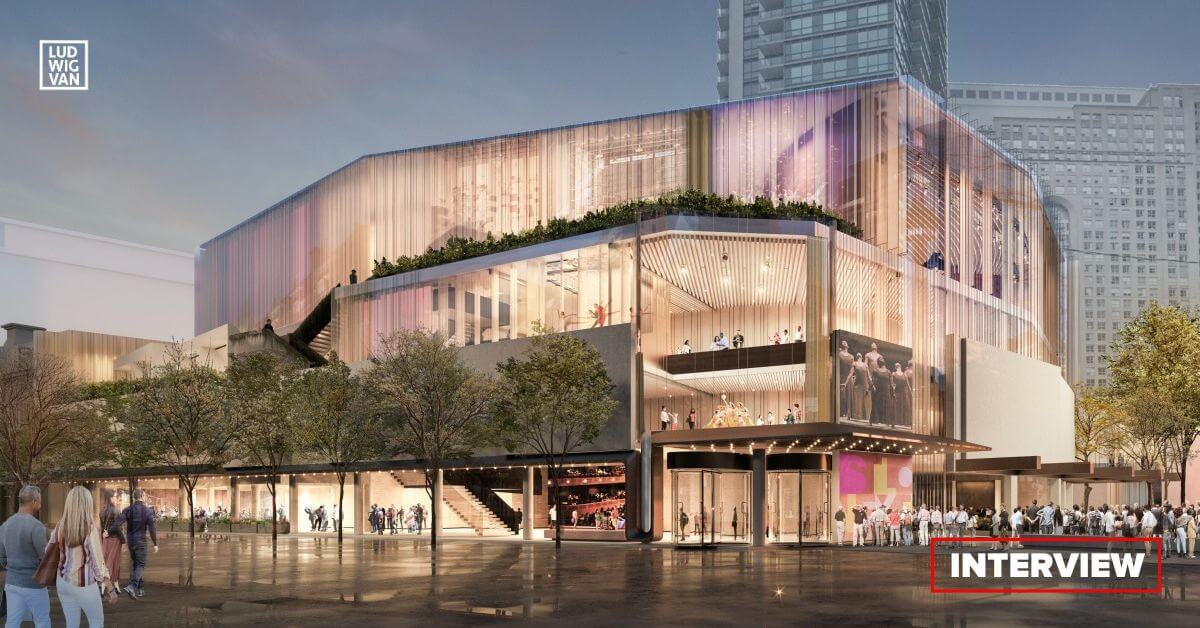
The St. Lawrence Centre for the Arts has been a fixture on Front Street East for more than a half a century. It has been home to both the Bluma Appel Theatre (868 seats), and the Jane Mallett Theatre (499 seats).
The structure represented the City of Toronto’s official centennial project, with planning that began during the 1967 centennial year. The Centre itself didn’t officially open until February 2, 1970, with a design by Gordon S. Adamson and Associates.
We talked to architect Siamak Hariri about the St. Lawrence Centre revitalization project, which looks to modernize and revitalize the venerable institution.

Siamak Hariri, OAA, AAA, AIBC, FRAIC, RCA, Intl. Assoc. AIA
Canadian architect Siamak Hariri was born in Bonn, Germany. He got his education at the University of Waterloo, followed by graduate studies at Yale University. He co-founded Hariri Pontarini Architects with David Pontarini after gaining work experience in Toronto and New York City.
He’s won numerous awards for his work, including five Governor General’s Medals in Architecture, and his portfolio includes prominent projects such as Princess Margaret Cancer Centre Space Transformation Project, along with many cultural institutions like the Art Gallery of Ontario Weston Family Learning Centre and South Entrance/ Grange Park Pavilions, the Tom Patterson Theatre in Stratford, Ontario, and the currently under construction OpenROM transformation of the Royal Ontario Museum.
Hariri Pontarini Architects is a full-service architectural and interior design practice. But, the fact that they’re located in Toronto was a happy coincidence.
Hariri Pontarini Architects (HPA) won the contract through an international design competition, a win that was announced in March 2023.
“We may have been one of two Canadians that made the short list,” Hariri relates. Even the process itself is onerous — he describes a brief that is about 800 pages deep. TO Live, the organization that runs the facility, was one of many jury members.
“It’s interesting that we did not actually present to the TO Live people, but to the jury,” he says. “I’m just really thrilled that a Canadian firm was able to win.”
The jury wanted a good story behind the design, along with a very credible proposal from all practical aspects. When it comes to cultural institutions, Hariri describes finding the right story for the project. “We had really searched for the essence, the soul of the story,” he says. In this case, the story was really so incredibly self evident.”
The brief describes a concept: creating a cultural district in the heart of Toronto’s downtown, taking inspiration from NYC’s Lincoln Center, with its outdoor plaza as well as indoor spaces — a facility that reached out, in effect, to the city that surrounded it.
Their winning design is called Transparence, and it describes much more than the quality of the outer wall covering.
Design Details
The original design is an example of the brutalist design aesthetic common to the era, with simple lines. The concert spaces were welcoming, but the outer face on Front Street doesn’t do much to engage passersby.
The new concept is to create a hub that will join the St. Lawrence with its neighbour on Front Street, Meridian Hall, another TO Live property, via an outdoor park with seating, and an overhang that will allow for outdoor events. People can simply come to the park, and then decide which venue or event to choose from.
“It’s a […] kind of coming of age in Toronto,” he says. “This was the first closing of an entire street that I knew of, in Toronto, to patch together two sites as one system, and then have that bridge across to another major park.”
Berczy Park will be part of the communal area.
“Another element that was strong in the brief, was that the design had to be self evident — it had to take the sidewalk right into the building,” he says.
The most immediately striking feature of the design is a high-performance transparent facade made of cutting edge materials that will wrap around the structure entirely. The transparence creates a luminous space inside, where the interiors are lined with wood, accentuating a feeling of warmth.

The Story of Toronto’s Vibrant Downtown
“The story of course has a metaphor, and the metaphor for us was that culture, essentially, has this invaluable role. It tells everyone (about) the soul of the city,” Hariri says. He likens it to gathering around the campfire to hear stories and music. “There’s a vulnerability, an openness, and a warmth.”
It’s a vibe that can help define a city, he feels. “One of the big mandates of the project [was] that it’s not only a home, but a welcoming place for people of different backgrounds,” he says. “Culture isn’t buying a ticket and finding a seat.”
The openness of the design encourages the eradication of any sense of exclusivity or elitism. “To create a model that’s much more open and inviting.”
Elitism is the scourge of contemporary culture. “We wanted to radically challenge this idea,” he says. “We are actually working with two Indigenous architects. I think it’s really important that we walk the talk.”
The area’s significance in Indigenous history has been acknowledged with the use of Wampum belts to signify agreements and collectives. Anishinaabekwe, Ojibwe architect Eladia Smoke of Smoke Architecture, a Master Lecturer at Laurentian’s McEwen School of Architecture, and her associates, designed the Wampum elements together with Wanda Dalla Costa, principal, Tawaw Architecture Collective.
The Wampum element is featured as a luminous line that extends around the structure from end to end. There will also be a ceremonial fire circle at Front and Scott Streets.

Four Floors for Culture & Connections
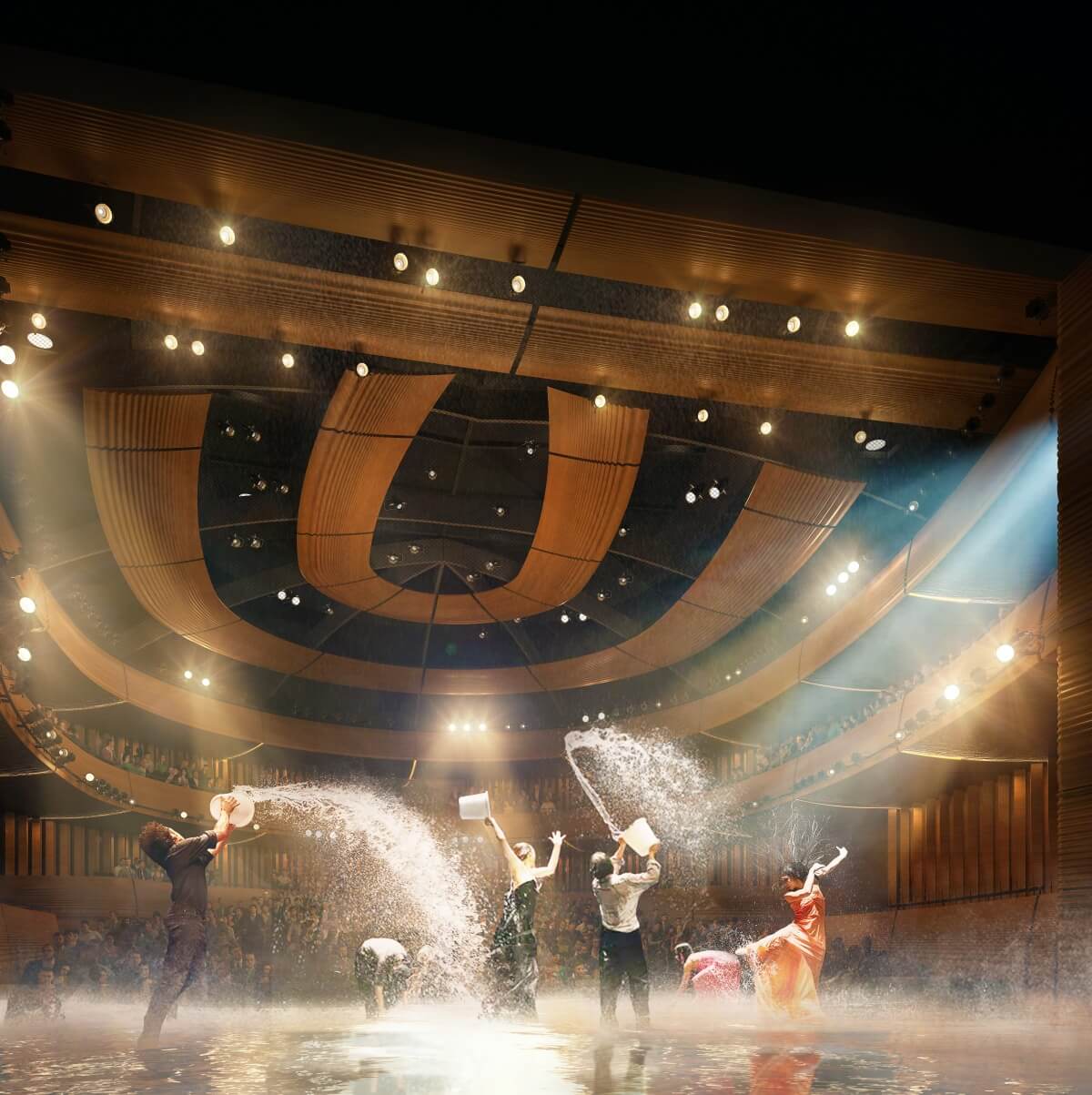
Once completed, the facility will be one of the first certified net zero performing art centres in Canada, including efficient systems, and on-site energy generation. The two main performance spaces are designed with state of the art tech and are fully accessible. The Main Hall and Acoustic Hall will seat 600 to 1,000, with retractable seating and partitions for maximum adaptability.
“That’s what we presented — a theatre that was convertible at the push of a button to a bunch of different configurations.”
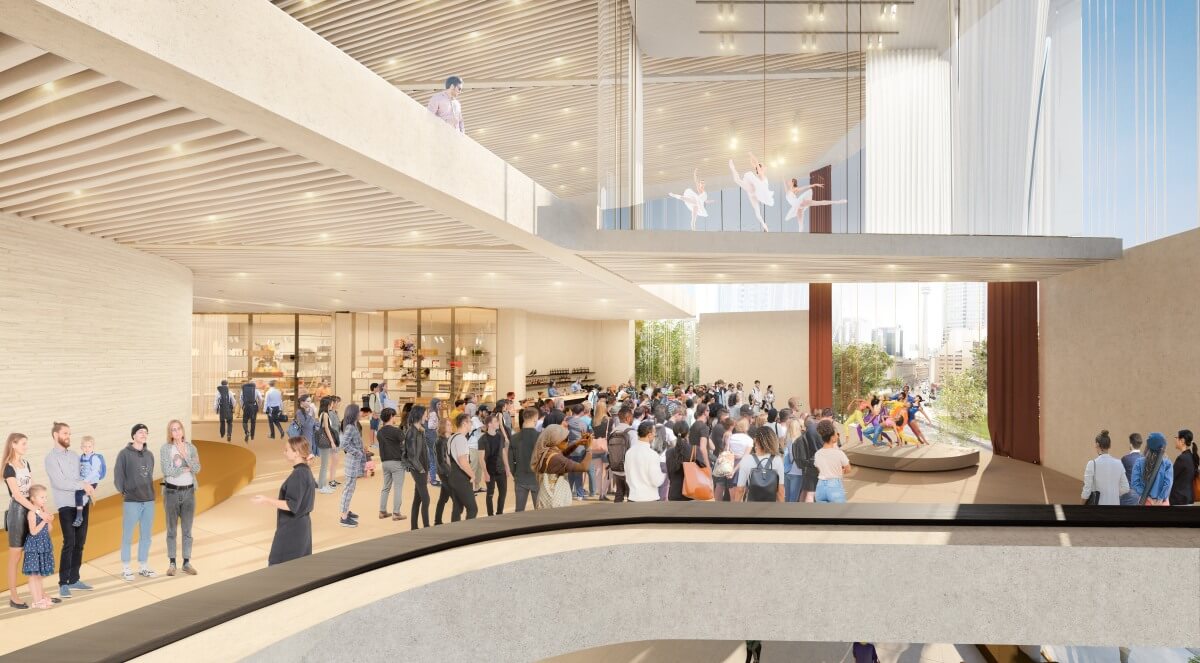
There will be four floors in total, with a welcoming lobby space, and Main Hall performing space on the main floor. The main axis of the Main Hall theatre has been rotated to create a new entrance on Scott Street.
The second floor will house studios and three rehearsal halls equipped with high tech audio and digital capacity, along with more informal performing spaces. Studios will occupy part of the third floor, along with the KidZone that will feature a separate entrance.
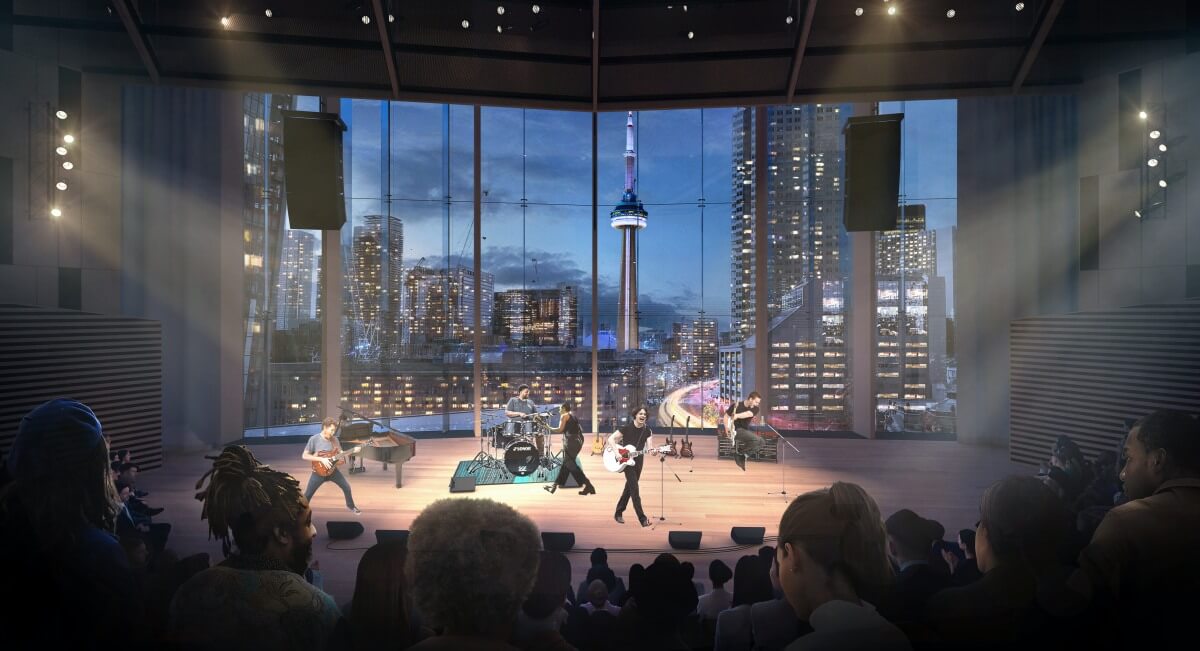
The newly reconfigured 400-seat hall will have a wall of glass that looks out from the fourth floor, stacked on top of the studios, with views of the CN Tower. “It’s a perfectly fine tuned acoustic hall,” Hariri promises. The Acoustic Hall will be designed for unamplified performance. With dramatic views of the Toronto skyline, the smaller hall will also have access to a garden terrace.
What’s entirely new will be both indoor and outdoor spaces designed for free use by the public, including a park/plaza that adjoins Berczy Park. The public facilities will be located along the Front Street facade, facing Berczy Park.
The facility can host a street party, a formal concert or other performance, with a glass facade that allows a streetview of everything from parties to dance rehearsals.
“I love this idea that, if this place really humming, […] it becomes transparent to the city,” he says. “If you combine that with the Meridian, you have a heck of a good ecosystem.”
The project is expected to begin in earnest in 2026, with a new STLC opening in 2030.
Are you looking to promote an event? Have a news tip? Need to know the best events happening this weekend? Send us a note.
#LUDWIGVAN
Get the daily arts news straight to your inbox.