
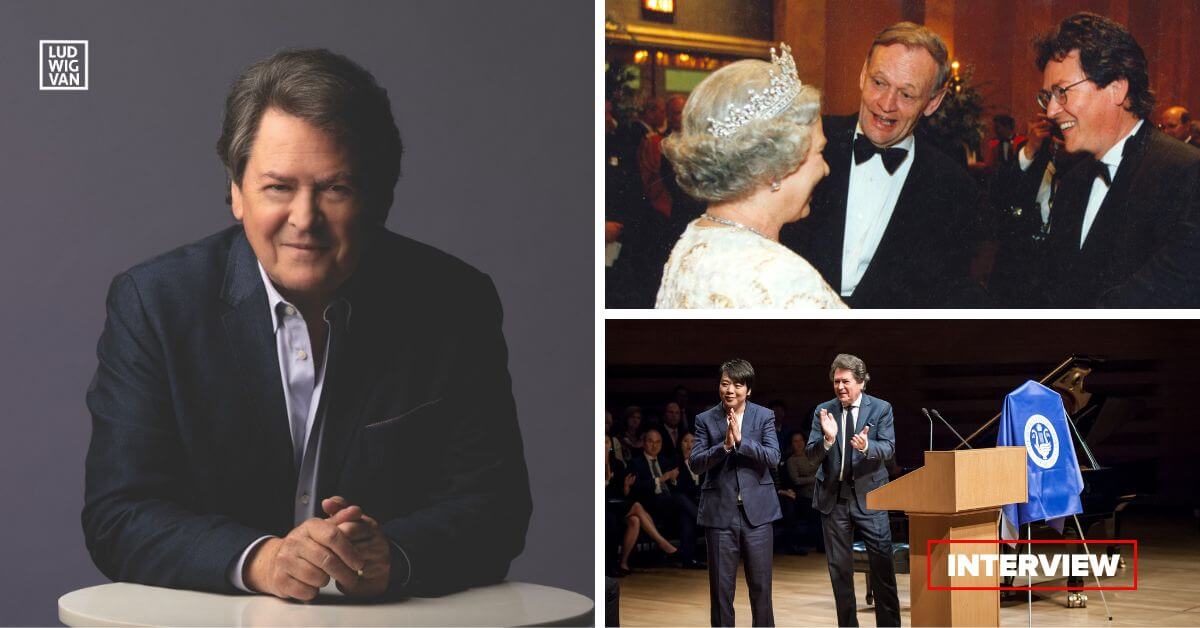
At the end of August 2024, Dr. Peter Simon will step down from his role as President and CEO of the Royal Conservatory of Music. During his tenure, the institution has become recognized as a leading educational institution, as well as home to a world class concert hall.
He’ll be replaced in the role by Alexander Brose, as the RCM looks to expand its reach beyond Canada in its next phase of evolution.
We spoke to Dr. Simon about his time leading the institution.
Dr. Peter Simon
Simon was born in 1949 in northeastern Hungary, in a small village where his father worked as an engineer. They moved to Budapest, but in 1956, fled Hungary altogether before Simon’s father could be arrested for organizing strikes to protest the Soviet invasion. They made it to Canada in 1957.
Naturally, Simon’s exposure to music didn’t begin as an administrator. He studied the piano with Boris Berlin at the RCM he would later head. He continued piano studies at The Juilliard School in New York, and then at the University of Michigan. There, studying with Leon Fleisher, he earned his PhD.
In 1986, he was the director of academic studies at the Royal Conservatory, where he brought Fleisher back to Toronto to teach and perform.
It was essentially on a whim that he applied for the job of President of the Manhattan School of Music in 1989. To his surprise, and with zero management experience, he won the appointment. His tenure would last two years. In 1991, however, the job was open at the RCM back in Toronto.
The Royal Conservatory of Music
To understand what Simon was coming home to, it’s necessary to delve into the RCM’s history.
The Royal Conservatory of Music was founded in 1886 by Edward Fisher on the upper floor of his music store at Yonge and Dundas. At that time, it was linked to the University of Trinity College. That changed to an affiliation with the University of Toronto in 1896. For just under a century, it grew to establish a national network of examination centre, with annual performances and a Canada-wide profile as an educational institution.
It developed into a centre for both student and professional training. The Canadian Opera Company grew from within its opera division, and it produced a generation of prominent musicians and teachers, including Glenn Gould, Mario Bernardi, Teresa Stratas, and others.
But, Simon returned to an organization poised organizationally for the future, but also dealing with financial shortfalls and other assorted problems.
From 1963 until 1991, the RCM has been governed entirely by the University of Toronto, which squeezed it out of its original home. The Conservatory landed at its current home on Bloor Street, but lost most of its concert and recital halls, along with the library in its entirety, and three pipe organs in the process. Without adequate funding, the institution entered a period of decline.
In 1991, the RCM became independent from the University of Toronto through an act of the Ontario Legislature. It was a fairly tumultuous time, you could say.
“It was pretty emotional for everybody,” Simon says. “What had happened was unfortunate.” Still, there was potential, despite the challenges. “It was what it was.”
“Cooler heads and wiser heads prevailed,” he says of the move to institutional independence. “People realized that the Conservatory didn’t fit within the university, and I commend the university for recognizing that,” he says. “I think it was a good thing for both parties.”
Three decades plus later, of course, both institutions are thriving as top notch music schools.

Back To Toronto
What plans did he have on leaving Manhattan some 33 years ago?
Overall, naturally, was his desire to “restore it as one of the greatest schools in the world”, as he describes it.
“Probably, three larger items that I thought could be done. One, prior to me going to Manhattan, I had started a professional training programs as an initiative to get the conservatory back to professional training, which had been part of its illustrious history,” he says. “One, was to build on that.”
He likens it to a model based on the example of the Curtis Institute, which incorporates a set of philosophical values. He wanted to develop a real community where students that were supported, mentored, and guided.
“Each student would have an individual identity,” he explains. “Our job was to take them from point A to point B.” The focus is always on the individual and their artistic voice.
“To do that would involve a certain type of instructor,” he elaborates. The kind of institution he envisaged would also incorporate more time for each student, specific facilities to accommodate learning and growth, and a welcoming environment.
“Canada had a great performance school at the RCM,” he says. “But all that was lost.” It was the right moment to rebuild that legacy. “I thought Canada needed a great training institution.” Canadian students could stay in the country to continue advanced training, and a high calibre institution would also attract foreign students.
A Concert Hall
“The building was obviously a big, big issue,” Simon notes. “There was no scenario that you could build a great institution as it existed.”
Once it had regained its status as an independent organization, the RCM was able to reclaim the building on Bloor where it is currently housed (formerly also home to McMaster University, among other things).
“It needed a concert hall.”
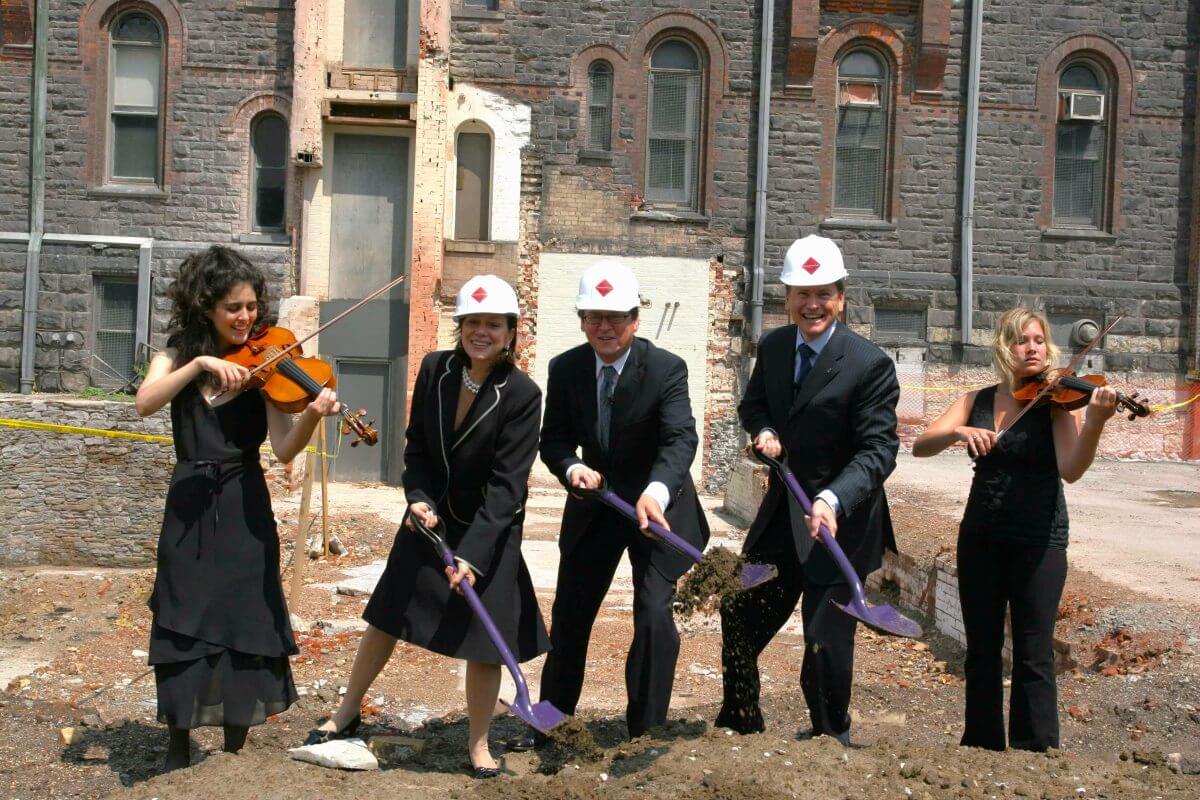
Construction work began on what was called McMaster Hall (now Ihnatowycz Hall) in 1991, eventually developing into the Telus Centre. The Mazzoleni Concert Hall was added in 1997. The front entrance was opened in 2002.
“I felt Toronto needed a great concert hall with superb acoustics, and I didn’t think we had one,” Simon says. “The building and the concert hall together were an item. I felt that the performance aspect was a must.”
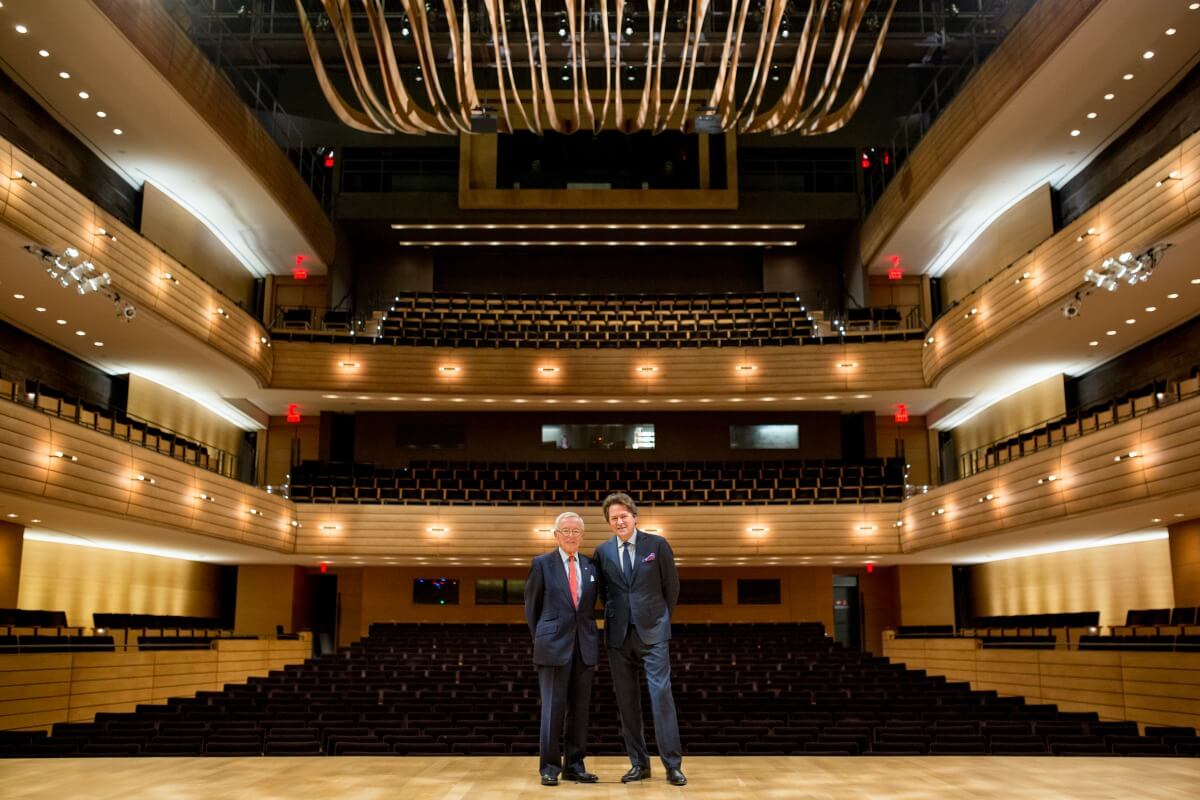
Koerner Hall, built at a cost of $110 million, would follow, opening in 2009 on what would have been Glenn Gould’s 77th birthday. It was designed by Marianne McKenna of the architectural firm Kuwarabara Payne McKenna Blumberg, already known for their work on the National Ballet School and other cultural institutions.
Performance connected the school with the city and its people, as well as creating and fostering connections between its students and international artists who arrive to perform, and also give master classes and mentor. “You need that kind of environment,” Simon explains.
“That was the second big thing on the list.”
The third big issue on his mind went beyond the confines of the RCM or Toronto to consider what he calls “the virtual elimination of arts programs” at public schools across the country. The infrastructure of music that made it part of people’s everyday lives was being eroded. “I thought we were headed for difficulties there.”
It led to his determination to strengthen the system of independent music schools and instruction that exists across Canada, and to hopefully to galvanize its expansion.
“[It] remains for me, the biggest catastrophe for education in my lifetime.”
Peter Simon’s Legacy
Among his other accomplishments, Simon reorganized the RCM’s activities in interrelated units, including the community and professional schools, the examination centre, and others. Enrolment, revenues, endowments, scholarships — whatever metric you use, it has increased dramatically over the course of his tenure.
Today, the RCM’s programs and educational services reach about a half a million people each year.
By the time he leaves the position at the end of August, his tenure will have lasted 33 years. It has been marked by expansion and consolidation. That has included a number of initiatives, such as:
- Creating the Learning Through The Arts (LTTA) in 1994, which puts music back into public education, and has benefited more than 300,000 students at 300 schools;
- Launching The Glenn Gould School (GGS), an internationally recognized school, in 1997;
- Creating the RCM Certified Teacher Program;
- The Digital Learning division was launched in 2014;
- The Taylor Academy restructured and renamed as The Phil and Eli Taylor Performance Academy for Young Artists in 2013, with an impressive list of grads that includes pianists Tony Yike Yang, Jan Lisiecki and Stewart Goodyear, violinists Blake Pouliot and Sarah McElravy, and mezzo-soprano Ema Nikolovska among others;
- The founding of the ARC Ensemble, made up of RCM instructors, in 2003;
- The establishment of The Marilyn Thomson Early Childhood Education Centre;
- Launched the Artist in Residence program with pianist Stewart Goodyear;
- Renamed of the RCM’s community school, now the Oscar Peterson School of Music, and launched its tuition-free education program.
On January 1, 2024, Dr. Simon was announced as one of the new appointees to the Order of Ontario for 2023.
The Importance of Music
What kept him going through the work he saw needed to be done?
“I am optimistic by nature,” Simon says. “I just don’t think you can be a leader and not be optimistic. If you give up on the future, you give up on life. And, it’s not a good place to be,” he says. “You’re obliged to be optimistic, and to seek solutions at all times.”
It’s an optimism married to a deep passion for music.
“I have the most profound belief in the importance of music in peoples’ lives and in society. Music has to be in education, and in everybody’s life.”
He mentions the importance of the kind of emotional awareness that music education encourages as a by-product, and the ability to foster connections and open up to other human beings. He calls opening up the imagination “critical”.
“Everything in life arises from a vision of the future. You have to be able to imagine the future. How else do we prove that we’re alive except through some artistic presentation?”
He believes it’s essential to educational development. “[There’s] a very delicate transformation that happens in young people,” he says, “and music is critical to their psyche. If that’s not developed, then what do you get?”
Without it, there’s a vacuum. “You’re not giving people a moral compass or a moral vocabulary,” he says. “I believe so deeply in this.”
It’s a belief that has endured more than three decades in the trenches.
“For all these reasons, it makes me very determined.”
Are you looking to promote an event? Have a news tip? Need to know the best events happening this weekend? Send us a note.
#LUDWIGVAN
Get the daily arts news straight to your inbox.