
Dutch pianist Jeroen van Veen has recorded two CDs for Brilliant Classics that contain all the music written for the piano by Arvo Pärt. Hearing it in one sitting becomes a fascinating portrait of Pärt’s evolution as a composer. It showcases strengths and also weaknesses.
Pärt, born in 1935, started off as an experimenter within the many strictures of Soviet-era Estonia. After hitting an aesthetic dead-end, he remade himself as a sort of minimalist in 1976 — Pärt calls his musical framework Tintinnabuli (little bells) — eventually earning him fans among performers and listeners around the world.
The Estonian has never really been a composer for the piano, which adds an extra layer of the unusual in this collection of music. Pärt uses the piano as a vehicle for ideas rather than as a means to evoke emotion or stimulate awe. And, curiously, his relationship with this versatile instrument was virtually nonexistent during the most experimental 1960s.
Für Alina, as well as several other pieces, is written without a specific time signature and allows the performer to repeat all or part of it as well as play sections in different octaves. The score is only two pages long, but it can, in theory, be played for hours. (The four versions we get on the album last 20 minutes, 2-1/2 mins, 3 mins and 23 mins.)
In other words, this music doesn’t recognize a destination. Bringing it to life is not a performance, but an act that involves suspending time and narrative expectation. Playing it as well as listening to it successfully is as much an act of deep meditation as anything else.
Van Veen takes us there effortlessly, finding that delicate balance between stillness and motion with a clear, delicate but sharply articulated sound.
On the other hand, the pianist (and his occasional duo collaborator Sandra van Veen) have decided to keep the sound pure, choosing pianos with uninteresting harmonics. The arrangements not originally written for two pianos, such as Spiegel im Spiegel, suffer a tiny bit because a piano’s struck string can’t sustain a tone the same way a violinist’s bow can.
The older pieces are standard narratives that are easy to listen to, but don’t display particular originality. The best, in my opinion, is a four-movement Partita from 1958 that cleverly straddles serial and neoclassical writing without ever being fully atonal. Its second-movement Fughetta is very clever, and the Larghetto, in the naturally dramatic key of B minor, foretells of the deeper musical work to come in Pärt’s middle age.
But it is music where we hear the composer’s academic music-writing gears whirring, rather than being transported to another place.
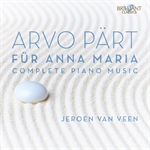
This album — Für Anna Maria: Complete Piano Music — is a great introduction to Arvo Pärt, in a climb-in-from-the-kitchen-window kind of way.
You’ll find more details here.
This is van Veen performing Für Alina in Utrecht in June, 2012:

And this is a very poised young New Zealand pianist, Harry Ellerm (now studying at Canterbury University), taking us through the Partita — the movements are marked Toccatina, Fughetta, Larghetto and Ostinato — in 2008:

John Terauds