
Toronto’s Art of Time Ensemble reprises one of its classical-meets-pop projects on Friday and Saturday nights this week at the Enwave Theatre. This show is about how the music of the past — in this case the art songs of 19th century composer Franz Schubert — can find echoes in 21st century indie pop.
I won’t be able to go, so I thought I’d introduce it with an interview I did with John Southworth for the Star six years ago, when artistic director Andrew Burashko débuted this programme.
This time around, Burashko is joined by National Ballet Orchestra concertmaster Benjamin Bowman and cellist Rachel Mercer to accompany the vocal work of Carole Pope — who replaces Sarah Slean from the original show — Martin Tielli, Andy Maize, Danny Michel and John Southworth.
All the programme details are here.
+++
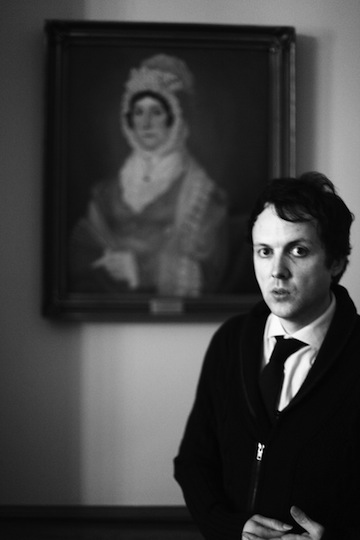
Southworth’s style is hard to pigeonhole – either as a singer or songwriter. The transplanted Brit has released five albums over the last nine years. At some points, he sounds like a noodly art-popper. At others, he is an old-time folkie. Then he turns around to capture something like a cabaret feel from 1920s Berlin or a Noel Coward who has been gargling with Mountain Dew.
His voice can be a smooth, honeyed baritone. Yet he often sings in a nasal-raspy tenor. For all the styles and moods, there is a lightness and playfulness in Southworth’s art that keeps attracting new fans.
…
Southworth said he was approached by Andrew Burashko four months ago. “Martin Tielli had passed my number along to him.” Burashko sent Southworth an email that described what he was looking for.
“When I received the email, I didn’t sit down and really read it, so I thought I was going to write a song that was a dark winter’s journey,” said Southworth, referring to Schubert’s Winterreise song cycle about a brokenhearted young man.
But then Southworth got it right. He listened to Schubert’s Piano Trio No. 2 and was soon on his way to crafting both music and lyrics to two new songs.
“In the first song, I wanted to make clear that I was using specific melodies from the Schubert piece,” Southworth explained.
“They are then extrapolated and taken in a different direction.”
The artist said the song, “Good Mourning,” is “a stuffy, somewhat bitter Noel Coward/Ivor Novello 1920s song.” But he was later inspired to rewrite it as “a Pixies’ modern song.”
“I’m not sure yet which one I’m going to sing in Toronto,” he added.
The lyrics certainly reflect his peculiar mix of deadpan, earnest and ironic, even in the opening lines “In the morning I will be mourning you/ Over devilled eggs and tomato juice/ I’ll be in my funeral wear/ Feigning despair/ And mourning for you/ Mourning for you feels good.”
He described the second song — “Zulou” — as “a fragment of a melody that, by the end of the composition had little to do with Schubert.” It was inspired by a picture he saw of Louis Armstrong dressed up as a Zulu warrior chief in a New Orleans parade in 1949.
“The music is somewhat intense,” Southworth added, with a chuckle.
Southworth is thrilled about his experience so far with Burashko’s inspiration. “The whole idea (behind the program) is about the creative process,” said the singer. “The idea of this project is wonderful. It allowed me to be inspired by a masterwork.”
+++
Earlier this week, the Art of Time Ensemble released this video of practice time with Andy Maize, who has written a new song for this week’s shows, “It’s Alright By Me:”

John Terauds