

Enjoy new music with our classical music chart for this week. Our weekly selections are based on sales numbers and simply what albums we love and think you NEED to hear.
For the complete top 20, tune into Classical Chartz with the New Classical FM’s Mark Wigmore every Saturday from 3-5 p.m. Find the full Top 20 list here.

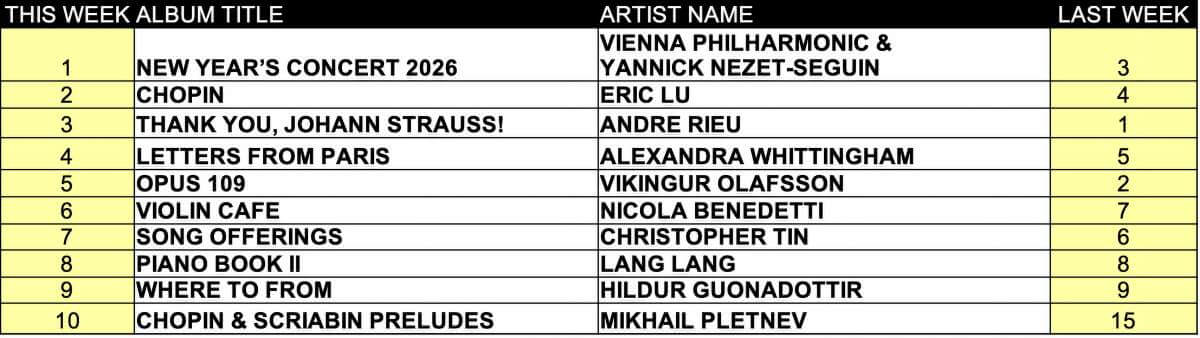
The Vienna Philharmonic, conducted by Yannick Nézet-Séguin, and their New Year’s Concert 2026 take over the top position in the Classical Chartz this week. They’re up two positions over last week’s Chartz. Eric Lu’s Chopin, a recording of his prize winning performance from the 2025 XIX International Chopin Piano Competition in Warsaw, comes in at No. 2, up from No. 4.
Rounding out the top three positions is Dutch violinist and conductor André Rieu and his Thank You, Johann Strauss!, a tribute to the composer’s 200th birthday anniversary. Also of note is the fact that Lang Lang’s Piano Book II is still on the Chartz after almost three months, coming in at No. 8.
The only newcomer to the Classical Chartz Top Ten is Russian pianist Mikhail Pletnev and his Chopin & Scriabin Preludes, which makes the leap from No. 15 last week to land at No. 10.
The Russian pianist, conductor and composer was born into a musical family (his father taught and played on the bayan, an instrument in the accordion family, and his mother was also a pianist) in what was then the Soviet Union. He began studying music formally at the age of seven at the Kazan Conservatory, followed by the Moscow Central Music School at 13, then the Moscow Conservatory.
His performing career was launched at age 21 with his Gold Medal win at the VI International Tchaikovsky Competition in 1978. He made his US debut the following year.
As a recording artist, he’s accumulated an impressive catalogue, including several recordings of Russian music with Deutsche Grammophon. Chopin and Scriabin: Preludes, however, is his first with DG in decades. The recording was captured on a pure analogue vinyl format (AAA), a first for DG.
Specifically, the 48 tracks consists of Chopin: 24 Preludes, Op. 28, and Scriabin: 24 Preludes, Op. 11. The two works were composed about a half century apart, and in terms of the prelude as a form, both composers diverted from the rules as set out by J.S. Bach in his seminal sets of Preludes and Fugues that appear in The Well-Tempered Clavier, BWV 846–893.
Chopin looked to free the form from the requisite that it introduced another work. He composed Preludes that were self-contained, and intended to be appreciated on their own. As for Scriabin, he wrote his own set of 48 preludes in all the major and minor keys as the result of a bet he made with his publisher, M.P. Belaieff. Op. 11 is the first set of 24, and follows Chopin’s circle-of-fifths model.
Are you looking to promote an event? Have a news tip? Need to know the best events happening this weekend? Send us a note.
#LUDWIGVAN
Get the daily arts news straight to your inbox.