
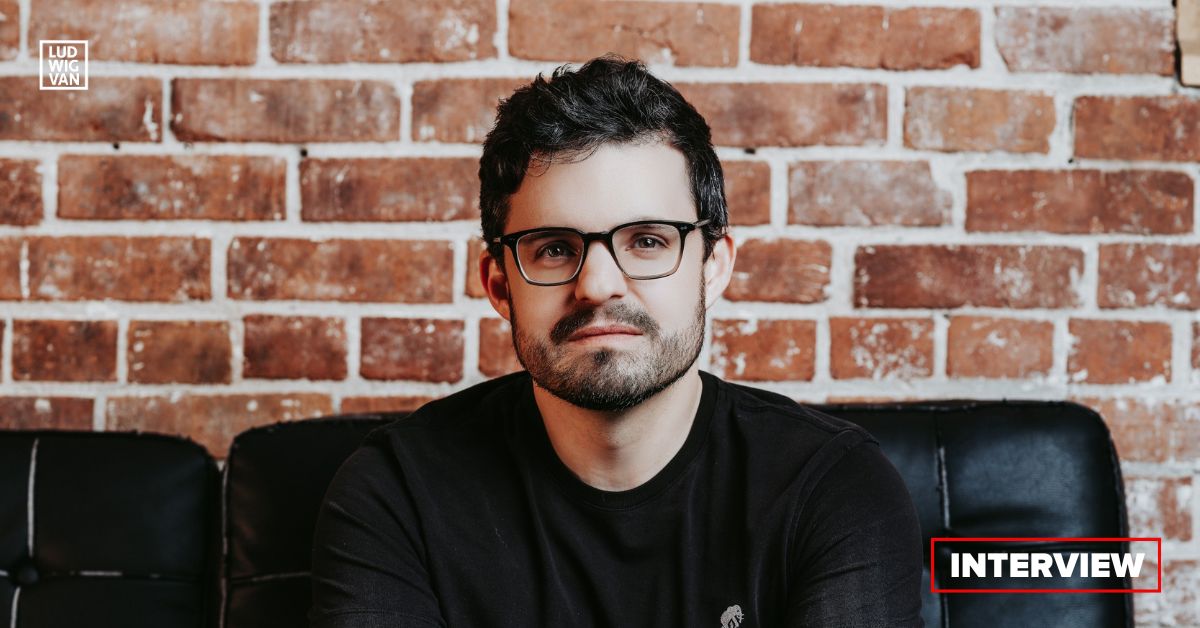
Music making and real life come together on the album A Flower For My Daughter by Ottawa-based composer Sean Clarke. It was the birth of his daughter that inspired the first works he wrote for the album.
The album includes a collection of intimate works for solo piano and pieces for flute and solo guitar, along with a miniature opera in 10 minutes for soprano and piano that’s set in Nova Scotia. The opera, Franey Trail, revolves around parenthood, memory, and the longterm consequences of the losses caused by war and conflict.
LV spoke to composer and flutist Sean Clarke about the album.
Sean Clarke
Composer and flutist Sean Clarke grew up in Calgary, and went onto study flute and composition at the Royal Northern College of Music and the University of Calgary, followed by a doctorate in composition from the University of Montréal, where he studied with Ana Sokolovic and Jonathan Goldman. Since 2017, he has been an adjunct professor at the University of Ottawa.
As a flutist, he’s performed with the Calgary Philharmonic Orchestra and the Red Deer Symphony, and at new music festivals in Montréal, Calgary, and Saskatoon, and in the Société de Musique Contemporaine de Québec’s Série Hommage concert series.
His compositions have been performed by the Toronto Symphony Orchestra, National Youth Orchestra of Canada, Gryphon Trio, Quatuor Bozzini, Land’s End Ensemble with Robert Aitken, and Ensemble Mise-En. They’ve appeared on two albums on the CMC Centrediscs label, and broadcast by the CBC.

A Flower For My Daughter
All the tracks on the album were composed by Sean Clarke, who also plays the flute. Other performers include Roger Feria Jr., piano; Talia Fuchs, soprano; and Nathan Bredeson, guitar.
The music is delicate and emotional, with a spare aesthetic.
Clark composed the album over a three year period that began just before his daughter’s birth. The first time parent was flooded with unfamiliar and heightened emotions that ranged from vulnerability to pure joy. His son also made his arrival towards the end of the period, amplifying those feelings.
Life takes on new meaning with children, and everything from cradling your sleeping child to taking a hike in the mountains has new dimensions. He looked to express those feelings in music, and for his children, who made their arrival on earth during tumultuous times — even though his own home was safe.
Sean Clarke: The Interview
As it happens, each of the performers on the album is also a composer.
“Roger, the pianist, has been one of my best friends since undergrad,” Clarke says. The two have performed together frequently; hence the focus on piano pieces on the album. “I really know his musicality.”
He worked together with soprano Talia Fuchs in the Halifax-based Opera by Scratch project a year ago, which pairs up six composers with six singers to develop six 10-minute operas over a week-long intensive. That’s where Franey Trail comes from.
“We workshopped it for a full week with that program,” he recalls. “She’s an improviser, and composer, and singer.” The back and forth exchange incorporates her advice on how to write for voice.
Likewise, he worked with guitarist Nathan Bredeson via a Canadian Music Centre initiative. As part of the process, Bredeson offered advice on how to write for the guitar.
“It’s a really close collaboration,” he says of both experiences. “They think about structure, and they think about expressiveness,” he adds.
Adding composition to performance only makes sense. “They think about their own expressive language so much, it just makes sense for them to have both roles.”
Composer-Flutist
His own music practice began with performance and taking lessons as a child.
“I was focused on flute,” he says. He studied via a Conservatory program in Calgary initially, where he says there were few opportunities to explore composition. When he continued studied as the university level, he made the most of the options it offered.
“As an undergrad, it was available, and I found it a fascination,” he recalls. “I started getting slowly into it.”
By post-grad, his focus was equally divided between flute performance and composing. “It was in the process. It really came from being a performer.”
As far as influences, he counts his two of his former teachers. “I think I was influenced a lot by two of my teachers.” He names Alan Bell at the University of Calgary and Ana Sokolovic in Montréal. That influence goes beyond the nuts and bolts of composition to elements like writing music connected to natural themes.
“With Alan Bell especially, there’s a connection with nature,” he says, citing the notion of inner worlds that are tied very closely to the natural one. “I found that really inspiring from the start. His music is very expressive, and economical, and dramatic.”
Bell’s music tells a story, he says, reminiscent of film scores, but using a different musical language.
What he took from Ana’s work is its freedom.
“It doesn’t sound like it’s written with a lot of structure or theory behind it,” he says. “It feels very free. That’s still one of my goals is to make it sound very intuitive and expressive.”
Sokolovic often dances, sings and improvises as she composes, as he notes.
“I always think of it, in film — you can get into camera angles, et cetera, but it’s background knowledge — the visceral feel of the film is paramount.”
Other influences came via his studies.
“I also studied the later music of Boulez when I was in Montréal. That also felt like it was in his world.”
As he points out, in his later works, Boulez loosened his modernistic approach, allowing traditional elements back into the music while still using a rigorous modern language.
Those influences can be felt in Clarke’s own music, which might be said to move towards expressive minimalism.
“I felt with these pieces, I wanted to pull back to the barest possible material to still be expressive,” he says.
His pieces open with a spare statement of theme, and become more and more expressive as the piece progresses.
“I use the pedal a lot. I like to work against the bareness. To blend the colours together, to create harmony.” It cuts down the prominence of melody to emphasize colour.
Composing The Album
“I composed pieces just for myself, slowly.”
The guitar piece had been written during the workshop, but Sean believed it would appear on Bredeson’s own album.
Some time after his daughter’s birth, he realized he had written a number of smaller works for piano. “I realized they were all thematic.” They all stemmed from the emotions following his daughter’s birth.
He added Winter Light, the final piece, as he was developing the album. “I thought it would be a good end piece.”
The album was recorded in a small, intimate studio in Montréal that was perfect for the album he’d assembled. “That kind of leant itself as well. It was a small space with a piano in the centre. I thought of it as kind of shooting a small movie.”
Recording the album and considering its reception for an audience required an adjustment in perspective. He hadn’t written the music for public scrutiny initially. But, another consideration became important.
“If I didn’t record them and promote them, then my children wouldn’t know,” he says. “That took my out of my shell and my comfort zone,” he adds. In the future, they’ll know their father through the music he’s written for them. “It’s a big shift.”
- Find the album to stream or download on Navona Records [HERE].
Are you looking to promote an event? Have a news tip? Need to know the best events happening this weekend? Send us a note.
#LUDWIGVAN
Get the daily arts news straight to your inbox.