
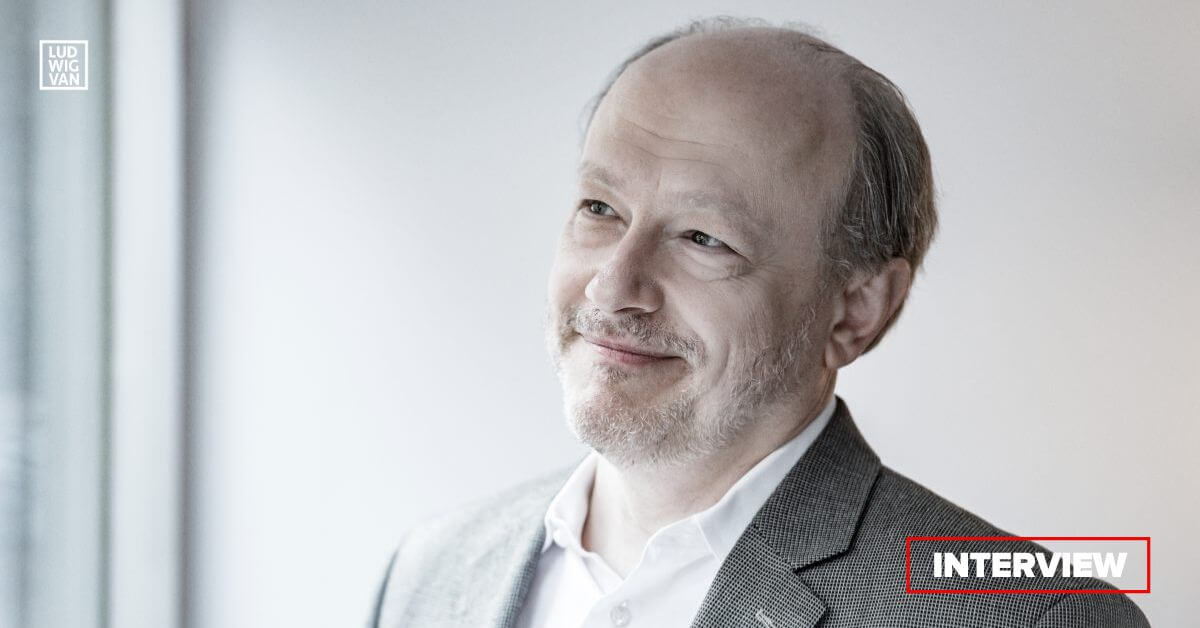
Marc-André Hamelin, OC, OQ, needs little in the way of introduction to any fan of Western classical music. The Canadian virtuoso is renowned for his technical mastery of even the most difficult of works. He’s been nominated for a GRAMMY Award no less than 11 times, and teaches on the faculty of the New England Conservatory of Music.
His upcoming release, Found Objects / Sound Objects (Hyperion, October 31, 2025) features the world premiere recording of Hamelin’s own work Hexensabbat, along with music by Cage, Wolpe, Zappa, Martirano, Oswald, and Wyner.
Along with his stellar career as a concert and recording artist, he’s garnered recognition for his own compositions.
Marc-André Hamelin, piano
Hamelin was born in Montréal, and his father, a pharmacist by profession, was a devoted amateur pianist. Marc-André began piano lessons at the age of five, eventually graduating from the École de musique Vincent-d’Indy. He went on to study at Temple University in Philadelphia, and in 1989, received the Virginia Parker Prize, awarded to outstanding musicians under the age of 30.
He’s gone on to a storied career that has seen him release several albums on the Hyperion label, along with performing across the globe. Hamelin is particularly known for his focus on lesser known composers of the late 19th and early 20th centuries, and for tackling uber-difficult pieces that few others perform, such as the notoriously challenging work of composers Charles-Valentin Alkan and Samuil Feinberg.
Marc-André has composed several works of his own, including a set of piano études, Con Intimissimo Sentimento, a seven-piece cycle, and many others.
Among his many accolades, he was made an Officer of the Order of Canada and a Chevalier de l’Ordre national du Québec (National Order of Québec), and has won seven JUNO Awards.
Hamelin’s piece Hexensabbat began as a sketch first written during his student days. It turned into a commissioned work from Le Piano Symphonique Festival in Lucerne.
Along with his own piece Hexensabbat, the album Found Objects / Sound Objects includes an arrangement of Frank Zappa’s Ruth is sleeping, Stuck on Stella by Salvatore Martirano, John Oswald’s Tip, John Cage’s The perilous night, Passacaglia by Stefan Wolpe, and Yehudi Wyner’s Refrain.
The release date for his 92nd recording is October 31, 2025.

Marc-André Hamelin: The Interview
Hamelin began playing the piano at age five. When did he add composition to his music practice?
“It was 1993,” Hamelin says. “Well at the beginning it was very embryonic,” he explains. “I started playing when I was five.” It was all about emulating what his father the amateur pianist was doing. “As a little boy, what do you want to do? You want to do the same thing.”
Naturally, his early compositions were… unsophisticated.
“I started to scribble things that didn’t make any sense,” he says. It began with imitation, developing slowly over the years. “The impulse was always there, but it took many, many years,” he says, “before someone would want to listen to it. When you’re a child, you don’t really realize that.”
He began to think more seriously about composition while still a student. “It wasn’t until my late teens maybe. My first piece was a fugue. A Canadian publisher agreed to publish it.” That was back in 1993.

The Pianist-Composer
The pianist-composer as a figure flourished in the 19th century before, for whatever reason, that career was discouraged.
“I think over the course of the 20th century, there was a gradual entropy,” Hamelin says. “It was encouraged less and less in the curricula.” As he points out, a good pianist in the 19th century would have been able to arrange music for the instrument, and probably also compose, as a matter of course. “That somehow got eroded over the years.”
It’s an attitude that has been changing over the last few years. “It’s only recently. I think there’s been a sort of revival,” he says. “There’s even a few improvisers on the scene, which is even better.”
He began writing for a simple reason. “I started, really, and I confess, I started writing because I wanted something of mine that I could play.” That remained his focus for years. “My intentions have been shifted for other people to play principally.”
While he does admit that his earlier works were often technically very challenging, and tended to frustrate other musicians, he’s focused more on expression these days. As he points out, many composer-musicians of previous eras, while they may have been virtuosi in their own right, wrote music for everyone.
“There’s plenty of music that’s written by these people that isn’t virtuosic at all,” he notes. “You have to write for pianists of lesser ability than theirs. The music is very approachable. I should emphasize that I don’t seek to write music that is difficult to play,” he adds.
In his very early compositions, he explains, he didn’t have the ability to distill his thoughts in a way that would make them more approachable pianistically.
“Which is why some early pieces, like those 12 Etudes in All the Minor Keys are attempted by very few people,” he says.

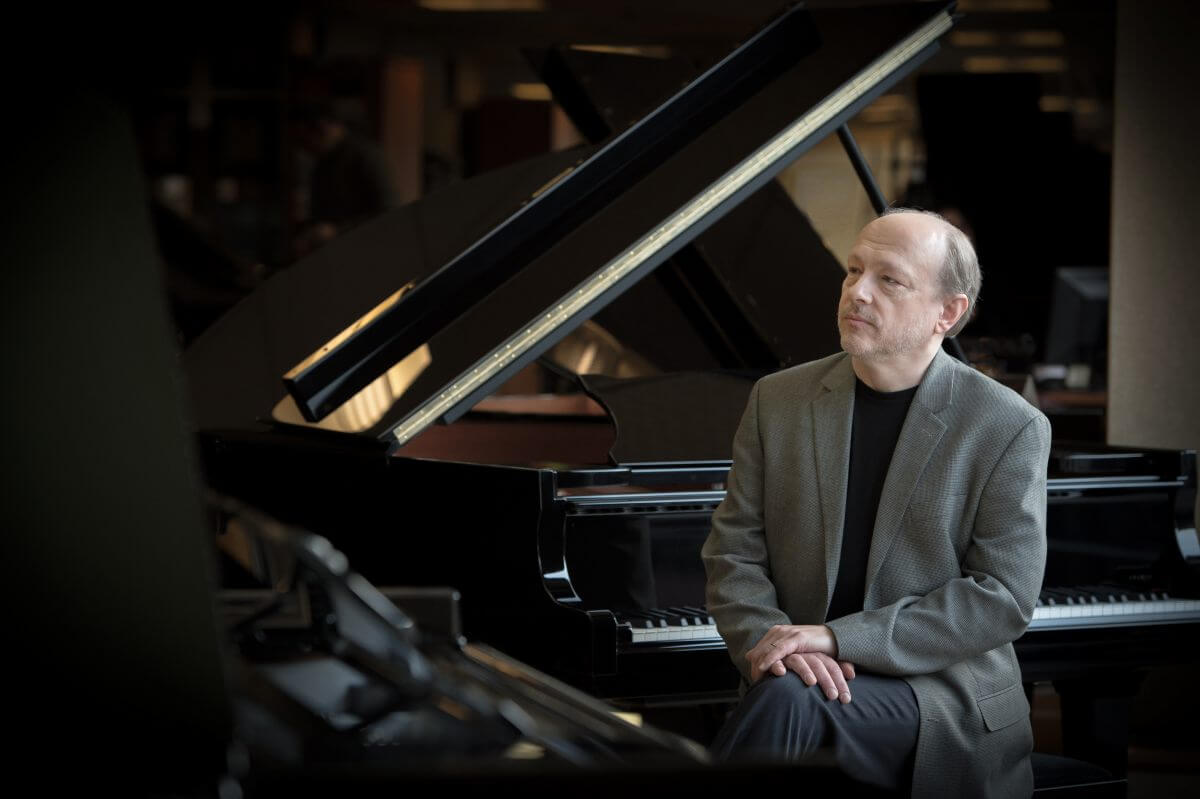
His Own Music
“I’m a bit of a lazy sort. I don’t have to live from performances. Composition for me will always be secondary to my performing career, but I regard it really as essential,” he says, “and I do feel like I do have something to say.”
He’s found his work gets a positive response. “I’ve generally been well received,” he adds.
“I always have something to express, and the language that I use, I think, is an unconscious, or a subconscious distillation of everything I’ve been exposed to.”
His music is largely tonal, even though he’s thoroughly modern in approach. “I use the tonal language very, very freely,” he adds. “As far as a detailed explanation of my language, that’s for others to say.”
While he naturally wants his intentions to come across, in the end, you have to allow for others to interpret as they will.
“You’re in a situation where it’s very easy to either overlook or willfully ignore what the composer has put on the page. What can you do?”

The Album & Beyond
The album includes unusual choices, like the Frank Zappa piece, which began as a work for synthesizer, then two pianos, before ending up as an arrangement for one piano. In the album notes, he writes,
“It may be surprising to many who think of Frank Zappa as a rock musician that among his early inspirations were such composers as Stravinsky, Webern and Varèse. His early attempts at composition were strongly influenced by these figures and, despite achieving his greatest fame in the pop world, he never abandoned writing for the concert stage. Those among my colleagues who share my fascination for the man lament the fact that he never wrote for solo piano, save for a tidbit called Piano introduction to ‘Little house I used to live in’ and the more substantial enclosure here, Ruth is sleeping.”
As he explains it, the material for the album was culled from performances over the last couple of years, and even beyond.
“The Zappa and others were part of last season’s programs,” he says. Many were recorded live on location. The John Cage work, which requires a prepared piano, comes from a taped live performance back in 2013.
As for next plans, he’s focusing on another more obscure composer, Brazilian Radamés Gnattali.
“I think it’s going to be a very interesting,” he says. “He’s one of the major figures in [South America]. He wrote a lot of concert music, but also, he was very active on the popular side,” Hamelin explains. “A prolific arranger. He wrote a lot of pieces in the lighter vein, choros, waltzes, and that’s what I wanted to centre on.”
Hamelin says he’s performed Gnattali’s work as encore pieces in performances, and they’ve always been well received.
“I just want Gnattali to be better known,” he says. “I think the repertoire is choice and very attractive.”
- Find Marc-André Hamelin Found Objects / Sound Objects on Hyperion [HERE].
- Toronto residents can look forward to catching Hamelin live on stage in a duo piano recital with Charles Richard-Hamelin (no, they are not related!) on March 29, 2026. Details [HERE].
Are you looking to promote an event? Have a news tip? Need to know the best events happening this weekend? Send us a note.
#LUDWIGVAN
Get the daily arts news straight to your inbox.