
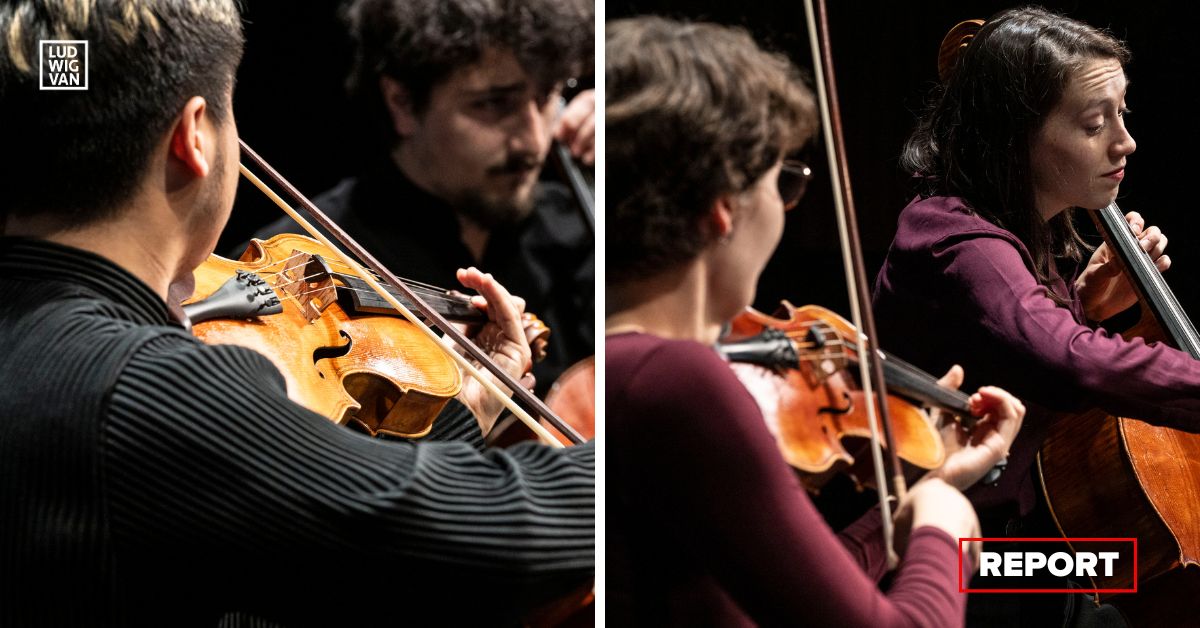
There’s no doubt that Barry Shiffman, the Artistic Director of the Banff International String Quartet Competition (BISQC) and the co-founder of the St. Lawrence Quartet, is a charismatic straight talker.
Gordon Lau, the violist of the Viatores Quartet, recounts that the first day that his group and the other eight contestants in this year’s BISQC arrived at Banff, they were given a tour of the eye-popping mountainous setting in the Rockies and the Arts Centre’s extraordinary facilities. Suitably impressed, Lau and all the musicians were then asked by Shiffman to look around a well-appointed room where they had congregated. He did, gazing at his fellow players and friends, not knowing what would happen next.
At that point, Barry Shiffman told them the blunt truth, “Most of you won’t win the competition.”
It was a shock for Lau and the other string quartets, invited from cities as far away as Seoul, Salzburg and Cincinnati, to understand that Shiffman wanted everyone to understand that first prize wasn’t the only reward being offered at Banff.

The Rewards of Competition
For Shiffman, who was a BISQC winner with the St. Lawrence Quartet in 1992, the notion that the award for playing at Banff should reside with only one group is clearly anathema. He’s made sure that all of the groups who come to the competition emerge as winners. Shiffman believes in the integrity of each group and that they all should emerge from Banff with their identities enhanced for an international audience.
The performances by each ensemble at BISQC are being live streamed on the Violin Channel to viewers worldwide. Shiffman and Banff have guaranteed that every string quartet will receive a $5,000 grant arranged by BISQC.
While at the festival, the string quartets are offered a Mentor-in-Residence, who is there to provide musical and emotional support. This year’s mentor is Mark Steinberg, the Brentano Quartet’s first violinist and a member of the faculty at the premier musical institution, Juilliard, in New York.
That’s only the beginning.
Since 2010, Shiffman has employed Toronto’s distinguished arts documentary company Riddle Films to profile every string quartet. Each ensemble chooses their favourite movement from a composition they love which is artistically shot by the Riddle team.
Afterwards, either Liam Romalis or Jason Charters, the founders of Riddle, interview a key member of the group. The best performance by the quartet is combined with key interview sequences to create a piece which is given to the groups so they can promote themselves with festival organizers, the media and the public. It’s a brilliant calling card for all BISQC entrants and a fine prize for each of them.
Film Shoots: Viatores & Magenta
The Riddle Films duo of Romalis and Charters invited Ludwig Van’s correspondent to observe them in action while filming two of the quartets, the Viatores and the Magenta.
The film shoot was in the Music Building’s Rolston Recital Hall, a wide room with high ceilings, which provides a vibrant sonic environment, perfect for instrumentalists. The large windows, facing west, offer gorgeous light which fills the space naturally. No artificial lighting is required, making the shoots easier to set up. It means that string quartets can enter the space and get ready to play with few technical distractions. They can relax and turn their attention to the music — which is, after all, what it’s all about.
Riddle organized the shoots in efficient manner. The quartets were invited to sit on chairs in the middle of the Hall, with cameras stationed to the right and left of them.
Two boom mics hovered above the performers ready to capture the acoustic sounds emanating from the stringed instruments. Next door to the Hall in a sound booth was where Riddle’s music engineer Pouya Hamidi captured the music. To the east of the performers was a metal track with a third camera placed on wheels ready to dolly from left to right, capturing the musicians in a dynamic way.
Riddle’s cameras are handled by a talented group headed by Kiarash Sadigh, DOP, accompanied by Derreck Roemer and Erik Sirke — veterans at documenting top musicians.
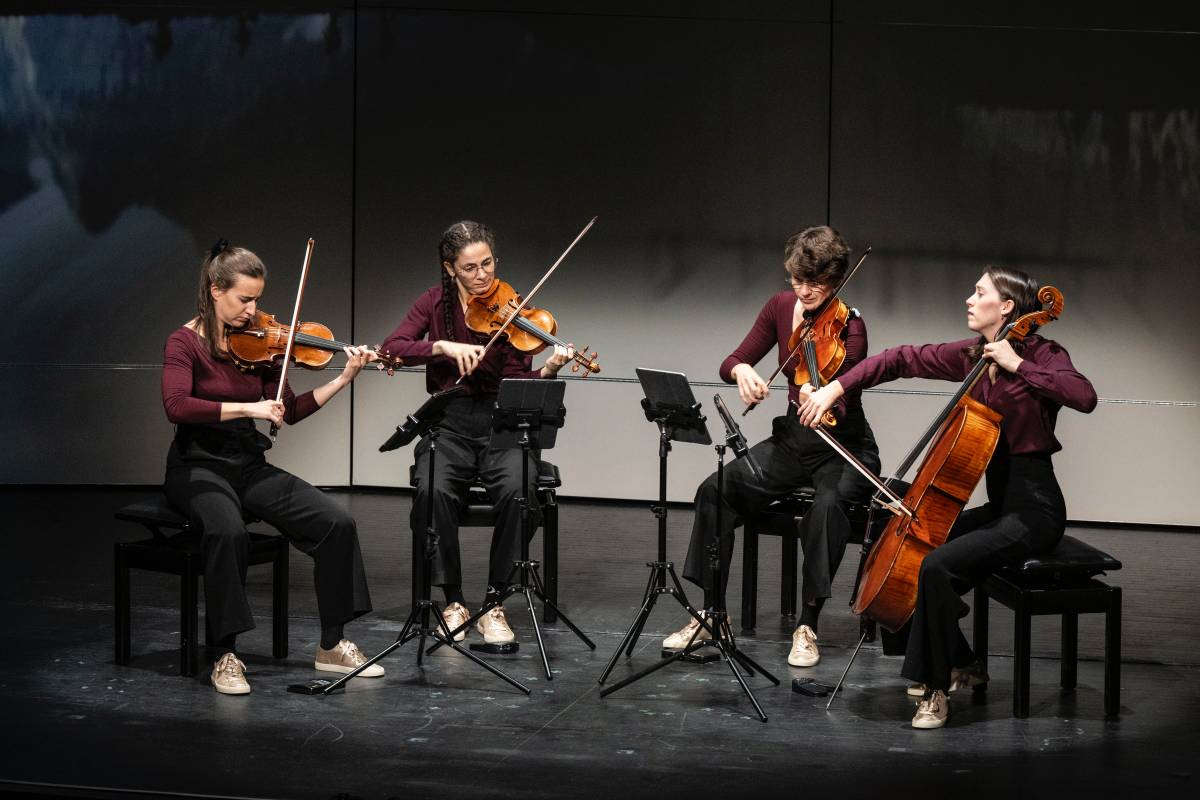
For each quartet, three takes were made of their preferred piece, a movement by an acclaimed composer. For Quatuor Magenta, a foursome from Paris that were understatedly stylish in black with signature grey sneakers, the chosen work was a dynamic segment from Robert Schumann’s String Quartet #1, which they played with aplomb.
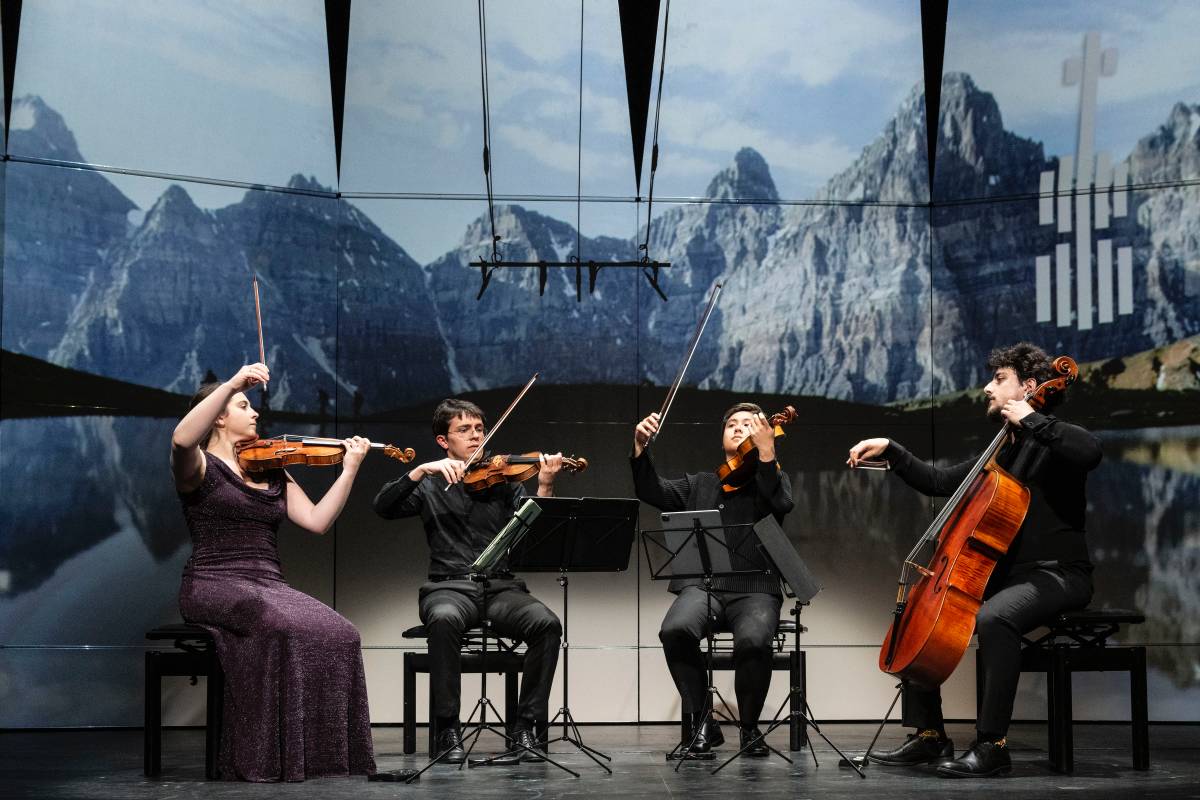
The Berlin based Viatores Quartet, by contrast, didn’t dress for the cameras but did play a spectral interpretation of the slow movement from Debussy’s marvellous String Quartet in G Minor, which almost arrested the air in the room with its beauty.
Following their performances, a chosen member of each quartet was interviewed by Jason Charters.
For Quatuor Magenta, Fiona Robson was selected, a fortuitous choice since she’s originally from London, Ontario — a rare Canadian artist amongst this year’s competitive string quartets. Robson projected a joyful if practical sensibility as she described how four students from the Conservatoire in Paris evolved into performing artists in France, moving seamlessly from small churches in rural hilly terrains to playing with Kronos in a prestigious urban venue.
When asked by Charters about their name, Robson replied that the four women lived near or on Rue Magenta and they enjoyed the colour, which they often wear on stage.
Gordon K. H. Lau, the viola player for Viatores, proved to be an articulate representative for a group of travellers, the meaning of their quartet’s name in Latin. They come from vastly different backgrounds but have found a common language in music.
Lau, from Hong Kong, the Turkish born cellist Umut Saglam, the British violinist Louisa Staples and German second violin Johannes Brzoska play astonishingly well together. Apart from the Hitler era, Berlin has always been a meeting ground for people of many cultures. For Lau and the rest of Viatores, it is a homebase from which they are building the reputation of their burgeoning string quartet.
As Viatores and Magenta prove, each string quartet has its own story. Riddle Films has done a masterful job in capturing their musical — and extra-musical — appeal.
Thanks to the support of Barry Shiffman and BISQC, it’s likely that many of the string quartets from this competition will be heard from again.
By: Marc Glassman for Ludwig-Van
Are you looking to promote an event? Have a news tip? Need to know the best events happening this weekend? Send us a note.
#LUDWIGVAN
Get the daily arts news straight to your inbox.