
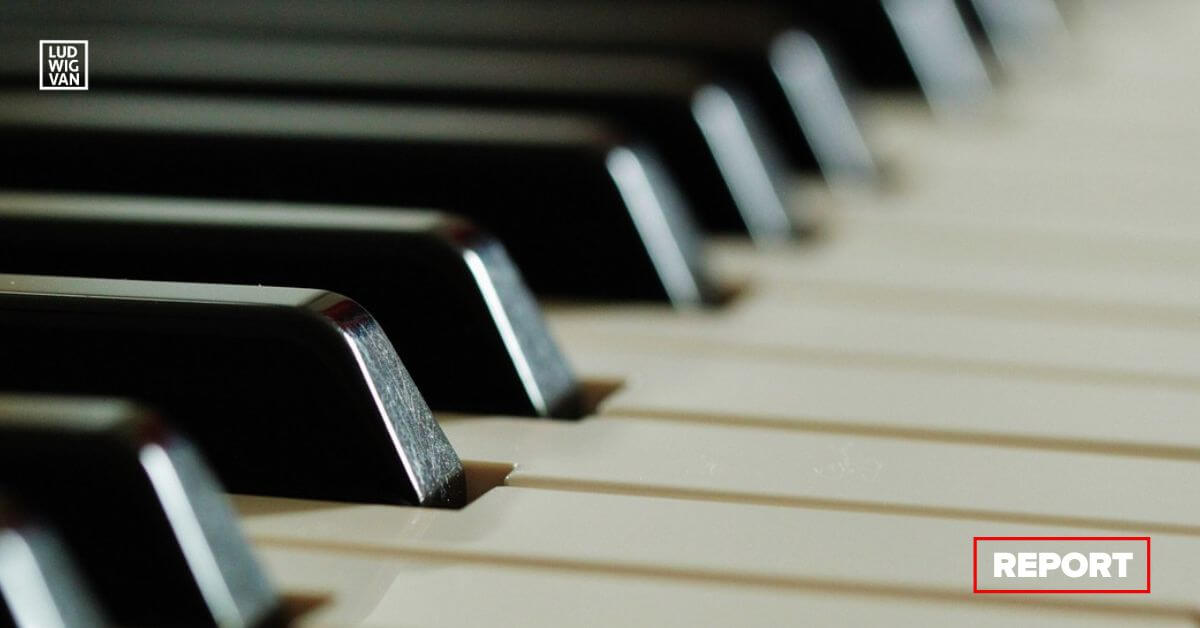
Narrow keys… Broad minds… No boundaries….
That’s the catchphrase for Stretto Piano Concerts, an organization founded by pianist and entrepreneur Hannah Reimann a couple of years ago during the pandemic. The stretto piano, simply put, is a piano with a smaller keyboard (about 7/8) that takes into account the existence of smaller hands.
This year, she held the fourth International Stretto Piano Festival, which recently took place from May 25 to June 4. The Festival included 16 concerts that were held all across the globe from San Diego to Stuttgart and Latvia, including six at Symphony Space in New York City.
It’s a revolution that is a long time coming.

Pianos for smaller hands
The design of the modern piano hasn’t changed significantly in the last century or so. Likewise, the mindset of many in the world of classical music, where there is still a reluctance even to admit the idea that hand size matters.
It does. In fact, the idea that using a single sized keyboard for the very wide physical variations of humanity doesn’t make much sense objectively.
A reduced repertoire, however, isn’t the only consequence or implication involved in the situation.
And, Reimann isn’t alone in her quest for piano equity.
Pask Piano, or ‘The Piano for Alternatively Sized Keyboards’, boldly proclaims, “If everyone plays the same size, most are playing the wrong size!” on its website. There’s a petition that interested musicians can sign at the bottom of their webpage.
They’ve also gathered some data to support their position, namely, that stretto pianos should become part of the regular options available to musicians.
The published Proceedings of the 9th Australasian Piano Pedagogy Conference: Expanding Musical Thinking, held in Sydney, Australia in July 2009, review the available studies and literature, including epidemiological research, for a good summary of the situation.
The evidence of their benefits is there. The musicians who’ve adopted smaller keyboard pianos report pain relief, along with improved technical skills and greater overall comfort.
- The data also reveals a distinct gender bias, in that the average hand span of someone assigned male at birth (measured from thumb to fifth finger), is about 1” or 2.5 cm larger than that of the average adult assigned female at birth. That amounts to an average of one extra white key on a standard-size keyboard.
- A review of the studies, largely from the field of performing arts medicine, finds that pianists assigned female at birth run about a 50% high risk of pain and injury, and some found that percentage as high as 70% to 80%. Children and teenagers were also found to be at a higher risk of pain and injury from playing piano.
- That research was backed up by a 2021 study titled Interaction between hand span and different sizes of keyboards on EMG activity in pianists: An observational study. Australian researchers tested pianists on keyboards with three different sizes, including standard. The biomechanical data provides support for the idea that small handed pianists face a significant challenge with standard pianos based on ergonomics. Electromyography (EMG) tests revealed greater strain on the muscles and structures of the forearm and hand when pianists with smaller hands played a standard piano.
A little known secret…
Binyan Xu, a UK pianist and music scholar, is conducting research into small hands and pianists, which, as she notes, is described as a “disability” by noted British pianist and writer Harriet Cohen in her book Music’s Handmaid. Xu, however, seems to question this notion, and points to examples of noted pianists like Martha Argerich and Daniel Barenboim, both noted to have smaller hands. Perhaps talent and ingenuity can overcome the physics, and perhaps pianists with large hands also face challenges.
The use of Barenboim, however, makes a couple of notable points. First, that the pianist has never been a fan of Rachmaninoff. Rachmaninoff is the scourge of small-handed pianists. Notably, the composer himself was 6’6” tall, and his hand could span a 13th.
Second, Barenboim is known to have commissioned pianos with smaller keyboards to perform at recitals. That fact has been kept fairly quiet, and is not widely known.
Step No. 1: Acceptance
Pianos with smaller sized keyboards have been available since the 1990s. Getting the industry — i.e. musicians, manufacturers, concert halls… — on board is another story.
“The piano manufacturing industry would have to take on a massive project in order to change the size of keyboards and all their existing concert instruments in concert halls all over the world,” Reimann notes in an interview with NPR. “And manufacturing has been standardized for a product that has thousands of parts,” she adds. Reimann herself uses a custom-designed keyboard that she can slide in and out of her vintage Steinway.
Reimann’s call to arms has been taken up by some piano companies, an important step. The Klavins Piano company has produced the Una Cords Stretto, with specs that differ from the standard piano in important ways:
- The octave width measures 5.8” (147 mm), in contrast with the traditional pianos’ 6.5” (165 mm) octave span.
- Narrower strings and action scaling mean produce keys that remain straight, optimizing touch control, and repetition speed.
“This is a product that is taking time and influence to be produced more widely,” Reimann explained. “What’s needed is really people playing concerts on the (stretto) piano, so that everybody knows that they exist.”
Are you looking to promote an event? Have a news tip? Need to know the best events happening this weekend? Send us a note.
#LUDWIGVAN
Get the daily arts news straight to your inbox.