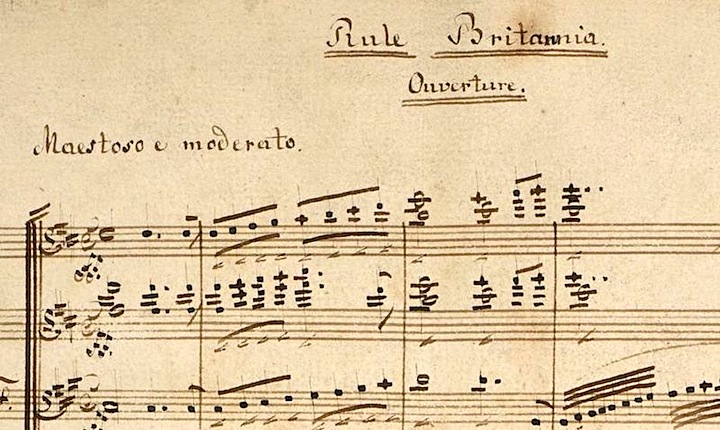
The world’s classical radio stations and websites have special Richard Wagner features today to mark the 200th anniversary of the German composer’s birth. More importantly, the British Library this morning posted a wealth of the composer’s manuscripts on its digital access site.
The image above, for example, is from a piece Wagner wrote for the Philharmonic Society in London based on Rule Brittannia. The concert presenter politely turned the composer down because the theme was thought too common. But the manuscript remained in London.
The earliest work in the British Library’s collection, which it says numbers about 2,000 publications and 20,000 recordings, is an Overture for a play, King Enzio, first performed in 1832 — before the composer’s 19th birthday.
Here’s a recording (it was posted on YouTube without credits):

The British Library’s Wagner collection does not include his greatest works: the late operas, with the exception of Der fliegende Holländer.
According to the British Library, the bulk of its Wagner collection was amassed by an aristocratic and politically connected Austrian contemporary of Wagner’s, sold the first time in 1887 (four years after the composer’s death), and purchased in its second sale, in 1937, by Austrian writer Stefan Zweig.
How ironic that Zweig, who was Jewish, had to flee his homeland in 1934. He and his wife were living in London when he bought the Wagner collection. His story ended unhappily in 1942, when he and his second wife committed suicide in Brazil, depressed over the fate of a world at war.
It’s impossible to consider anything Richard Wagner did without a mixture of exaltation and shame. A compulsive adulterer, deadbeat and anti-Semite, he wrote remarkable music and revolutionized opera.
As is so often the case with these big anniversaries, the British Library calls him “probably the most influential composer ever to have lived.”
That’s a bit of an overstatement. But what is amazing about the manuscripts that have been made available for viewing, is that we can contemplate the composer and his work, complete with all the scribbles and scratches — and not have to worry about the rest of his life.
Here is the Overture to Die Feen, Wagner’s first full opera, which he finished in 1833. Wolfgang Sawallisch conducts the Bavarian Radio Symphony:

You can check out the British Library’s Digitised Manuscripts site here — and be warned, there is so much other stuff there, you could get lost for days.
+++
Fellow Canadian blogger The Omiscient Mussel has revived her Operaplot Twitter game, in honour of Richard Wagner.
The rules are simple: Summarize the plot of a Wagner opera in 140 characters or less on Twitter. The contest is open until Sunday, May 26.
Here’s an example of what to expect, this one from tweeter Harriet Cunningham:
“Somewhere over the rainbow, way up high, There’s a castle for gods that Wotan built upon a lie.”
Check it out here.
John Terauds