
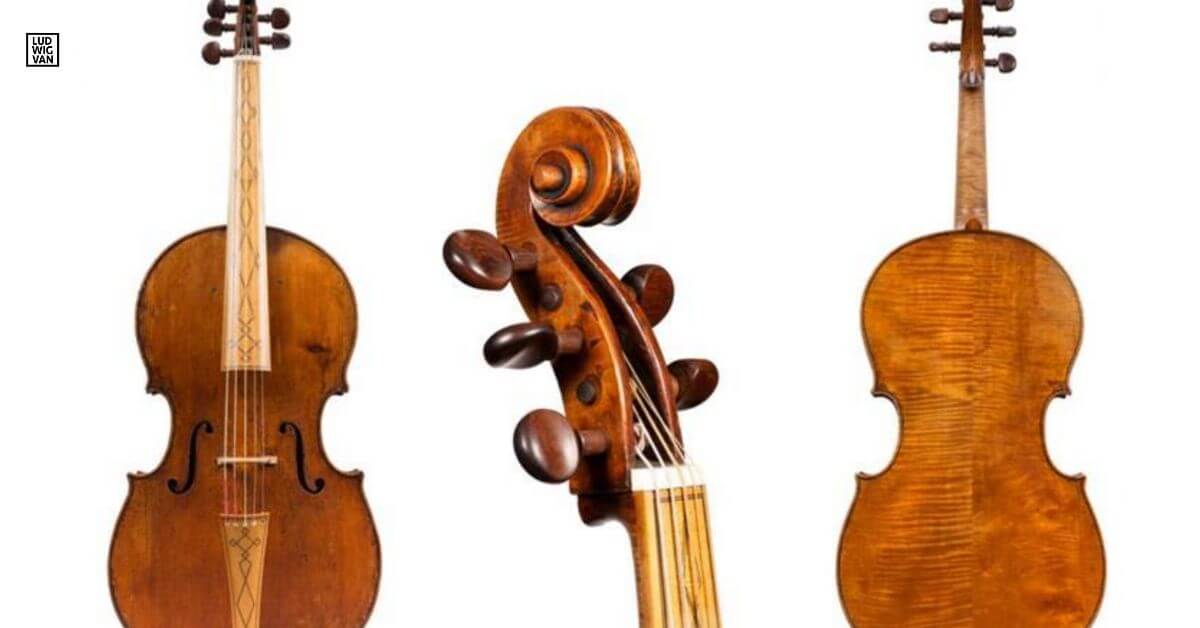
Those who think they’ve heard Bach’s cello suites played with historical authenticity may want to make a trip down to New York’s Metropolitan Museum of Art to see their newest musical acquisition.
What’s happening?
New York’s Metropolitan Museum of Art has acquired a five-stringed cello made by the Italian luthier,Girolamo Amati (1561-1630), c. 1610. The instrument is the only known five-string surviving cello in its original state from that period.
What makes this cello so special?
The Amati cello is connected to a musical dynasty. It hails from Cremona, Italy, the birthplace of Stradivarius instruments, which was declared a UNESCO intangible cultural heritage. Stradivarius studied with Girolamo Amati’s son, Niccolò Amati, and Girolamo’s father, Andrea Amati (c. 1511-1580), is considered the inventor of the modern violin family.
The cello acquired by the Met has a five-hole pegbox, short C-bouts and a processional hole on the back, suggesting it was likely played in a procession. (Read more on cello anatomy here.) It was discovered at an auction in the 1960s with its fifth peg hole blanketed off. J.S. Bach famously wrote his Cello Suite no. 6 for the instrument.
Where have I heard this before?
You probably haven’t. However, in 2018, the 19-year-old cellist Sheku Kanneh-Mason played a 1610 Amati cello at the Royal Wedding. It had four strings, though.
Hear cellist Keiran Campbell play Bach’s 6th cello suite on the “Amaryllis Fleming” five-string Amati Brothers Piccolo Cello here:
—


- Royal Liverpool Philharmonic Offers Injury Prevention Toolkit - March 10, 2025
- Marin Alsop Speaks Out About Trump and the Kennedy Center - March 10, 2025
- Are The Oscars The New Grammys?: Your 2025 Musical Oscars Round-up - March 10, 2025